
Table of Contents
1. Introduction
- Shower me hair fall ka common experience
- Fear vs reality
2. 💡 Quick Fact
- Telogen phase hair explanation
- Washing vs actual hair loss
3. Why Hair Falls During Washing (Biology Explained)
- Telogen phase hair
- Loose follicles & detachment
- Accumulated shedding
- Washing frequency impact
4. How Much Hair Fall During Washing Is Normal?
- Daily washing (50–100 strands)
- Every 2 days (100–150 strands)
- 3–4 days (150–250 strands)
- Weekly wash (250–400+)
- Context importance
5. When Hair Fall Becomes Concerning
- 300+ strands consistently
- Hair clumps
- Reduced volume
- Visible scalp
- No recovery
6. Does Washing Cause Hair Loss? (Myth vs Reality)
- Washing myth explained
- Breakage vs shedding difference
7. Hair Washing Mistakes That Increase Hair Fall
- Hot water damage
- Rough towel drying
- Harsh shampoos
- Wrong detangling
- Skipping conditioner
8. Seasonal Hair Fall vs Abnormal Hair Fall
- Seasonal shedding (Oct–Nov)
- Abnormal persistent hair fall
- Key differences table
9. Should You Wash Less to Reduce Hair Fall?
- Common misconception
- Risks of infrequent washing
- Ideal washing frequency
10. The Right Hair Washing Routine
- Lukewarm water
- Gentle shampoo
- Proper massage
- Conditioner use
- Safe detangling
- Microfibre drying
11. Additional Causes of Increased Hair Fall
- Nutritional deficiencies (Iron, Vitamin D, Zinc)
- Hormonal changes
- Stress impact
- Illness & fever
- Scalp conditions
12. Frequently Asked Questions (FAQs)
- Is hair fall during washing normal?
- Should I wash less?
- How much is too much?
- Sudden increase reasons
- Cold water benefits
- Hair on pillow & brush
- When to consult doctor
13. CTA Section
- Free Hair Fall Evaluation
- Personalized consultation
14. Disclaimer
- Informational purpose only
Introduction
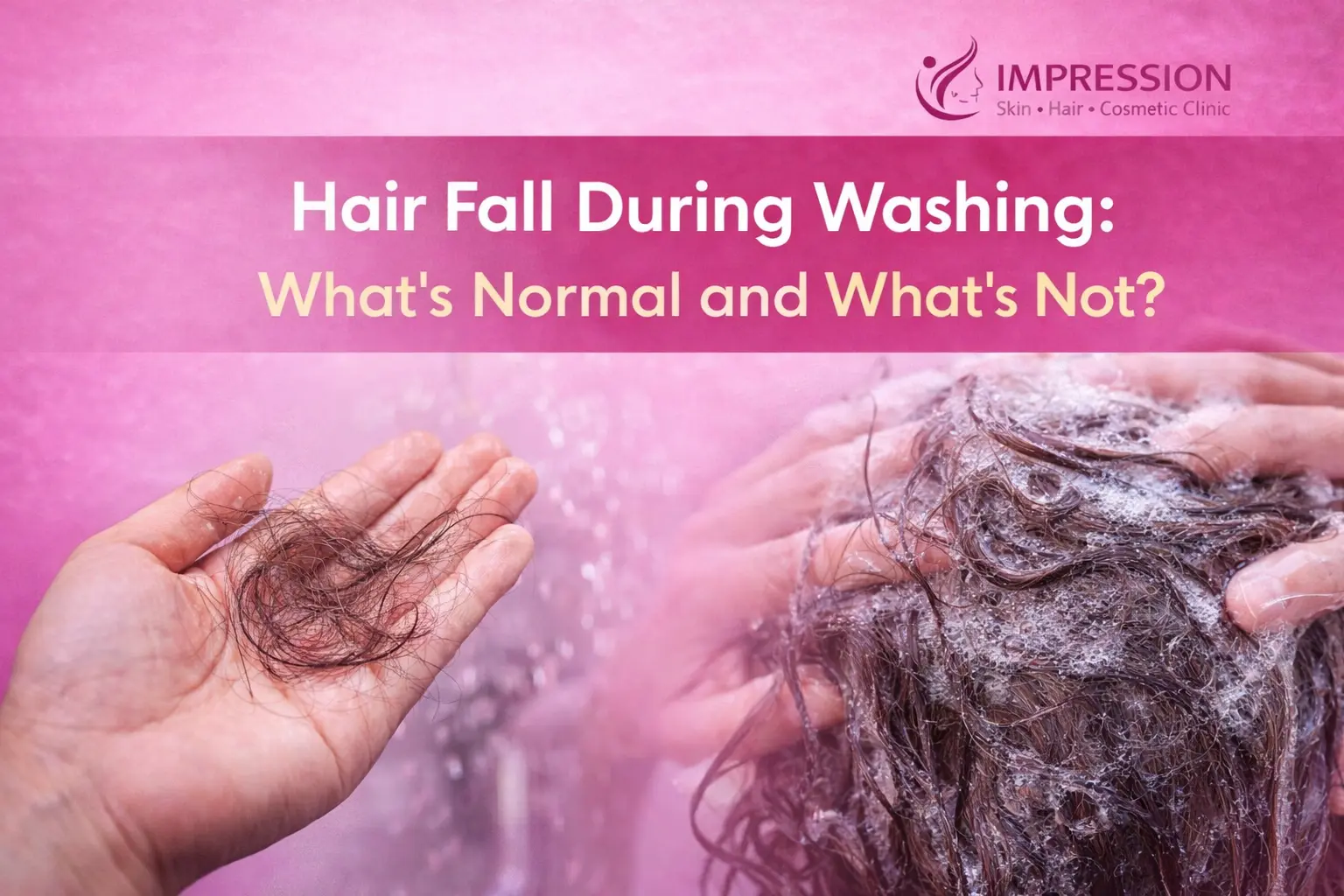
You lather up your shampoo, and the moment you begin massaging your scalp, clumps of hair wrap around your fingers. You rinse and find strands plastered across your hands, swirling down the drain. Your heart sinks a little.
But before you resolve to never wash your hair again — is this actually a problem? Is the washing causing your hair to fall, or is it simply revealing what was already going to happen? The answer, as with most things in hair health, is more nuanced than it first appears.
| 💡 Quick Fact
Hair that falls during washing was already in the telogen (resting) phase and fully detached from its blood supply. The act of washing doesn’t cause it to fall — it simply accelerates the exit of hairs that were going to shed anyway. |
Why Hair Falls During Washing: The Biology Behind It
To understand why you see hair in the shower, you need to understand how hair detaches from the follicle. A hair in the telogen phase is no longer anchored by the same structural proteins that hold a growing hair in place. It sits loosely in the follicle, waiting to be pushed out as new growth begins below it.
Water, massage, and the emulsifying action of shampoo all loosen this weakened attachment. So what you’re seeing in your hands during washing is:
- Telogen-phase hairs that were already loose in the follicle
- Hairs that accumulated since your last wash and are now dislodging together
- Hairs that were tangled and are now separating during the massage process
This is why people who wash their hair daily tend to see fewer strands per wash than those who wash every three or four days. The hairs shed more incrementally. Neither pattern is inherently more worrying than the other.
How Much Hair Fall During Washing Is Considered Normal?
There is no universally precise number, but here are the benchmarks that trichologists commonly use:
| Wash Frequency | Expected Strands Per Wash | Notes |
| Daily | 50–100 strands | Normal; hairs shed as they loosen |
| Every 2 days | 100–150 strands | Normal; accumulation of 2 days’ shedding |
| Every 3–4 days | 150–250 strands | Normal; large count is expected accumulation |
| Weekly | 250–400+ strands | Can appear alarming but is typically normal |
Context matters enormously. If you wash every day and suddenly see 300 strands per wash for two consecutive weeks, that is more meaningful than a person who washes once a week and routinely sees that amount.
| 🔴 When Counts Become Concerning
More than 300 strands per wash consistently (for a daily washer) Noticeably large clumps rather than individual strands Significant reduction in ponytail thickness or hair volume over 4–8 weeks Visible scalp that wasn’t visible before Hair fall not slowing despite resolving a known stressor |
Does Washing Your Hair Actually Cause Hair Loss?
This is one of the most persistent myths in hair care. Washing does not cause hair loss. However, certain washing habits can exacerbate shedding or damage hair to the point of breakage, which can mimic or worsen the appearance of hair fall.
Hot Water and Your Scalp
Very hot water strips the scalp of its natural sebum (oil), leading to a dry, irritated scalp. Chronic scalp irritation can disturb follicle health over time. Always rinse with cool or lukewarm water to close the cuticle and calm the scalp.
Rough Towel Drying
Wet hair is significantly weaker than dry hair. Aggressively towel-drying by rubbing causes breakage along the hair shaft. The resulting short broken fragments look like shed hairs but are actually breakage — a different (and more preventable) problem. Use a microfibre towel and gently squeeze, not rub.
Harsh or Sulphate-Heavy Shampoos
Shampoos with strong sulphates can strip the scalp’s natural oils, cause buildup, or trigger scalp inflammation. A scalp that is chronically inflamed or clogged with product residue is not an ideal environment for healthy hair growth. Choose sulphate-free formulas if you have a sensitive scalp or wash daily.
Detangling Wet Hair Without Care
Starting to comb through wet hair from the root leads to significant breakage. Always detangle from the ends first, working upward slowly. Use a wide-tooth comb or wet brush specifically designed for this purpose.
Conditioner Skipping
Conditioner closes the hair cuticle after washing, reducing tangling and breakage. Skipping conditioner — especially on dry, colour-treated, or heat-styled hair — makes hair more vulnerable to mechanical damage during washing and detangling.
Seasonal Hair Fall vs. Abnormal Hair Fall: Knowing the Difference
Many people notice cycles in their hair fall, and science supports this observation. Research published in dermatology journals suggests that humans experience a natural increase in telogen-phase hairs in summer and early autumn, leading to a shedding peak in October and November.
| Seasonal Hair Fall | Abnormal Hair Fall |
| Peaks in October–November annually | Occurs year-round or outside typical seasons |
| Resolves on its own within 6–8 weeks | Persists for months without resolution |
| No change in hair density long-term | Visible, progressive reduction in density |
| Both men and women experience it | Often linked to an underlying health trigger |
| No scalp changes or inflammation | May include scalp redness, itching, or scaling |
| Hair regrows to previous fullness | Hairs regrow finer, shorter, or not at all |
If your hair fall is confined to a predictable autumn window, lasts 6–8 weeks, and then resolves — this is seasonal shedding. If it persists well beyond this window or doesn’t resolve by the new year, seek an evaluation.
Should I Wash My Hair Less Often to Reduce Hair Fall?
This is a common instinct, and it’s understandable — if I’m losing hair when I wash, why not wash less? But this logic misunderstands what’s happening. Washing less does not prevent hair from entering the telogen phase or slow the underlying cause of shedding. It only delays when the hairs exit.
In fact, washing too infrequently can cause its own problems:
- Scalp buildup (sebum, dead skin, product residue) can clog follicles
- A poorly maintained scalp environment is associated with increased scalp inflammation
- Tangled, matted hair is more prone to breakage during the next wash
A healthy wash frequency is one that keeps your scalp clean and comfortable. For most people, this is 2–3 times per week. People with oily scalps may need daily washing; those with very dry or curly hair may wash once a week. Follow your scalp, not a rule.
| ✅ The Right Washing Approach
Wash with lukewarm or cool water Use a gentle, sulphate-free shampoo suited to your scalp type Massage the scalp gently with fingertips, not nails Always apply conditioner from mid-length to ends Detangle from ends to roots, using a wide-tooth comb on wet hair Pat dry with a microfibre towel — never rub |
Additional Factors That Can Increase Hair Fall During Washing
Beyond technique, several internal and external factors can increase the number of hairs you notice during washing:
Nutritional Deficiencies
Iron deficiency (anaemia) is the most common nutritional cause of diffuse hair shedding in women. Low ferritin levels — even without clinical anaemia — are associated with increased telogen hair. Vitamin D, zinc, and biotin deficiencies are also frequently implicated.
Hormonal Fluctuations
Postpartum women, those stopping hormonal contraceptives, and those approaching perimenopause often experience significantly increased shedding during washing. These episodes are typically temporary but can be distressing without understanding the cause.
High Physical or Emotional Stress
As discussed in its own right — cortisol disrupts the hair cycle. When you’re in a period of high stress, more hairs are simultaneously in the resting phase, and washing simply becomes the moment they all exit.
Recent Illness or High Fever
A fever above 39°C can act as a systemic shock to the hair follicles, triggering a wave of telogen effluvium. Shedding typically begins 2–3 months after the fever and can be alarming in volume. COVID-19 has become one of the most common triggers of this pattern.
Scalp Conditions
Dandruff (seborrheic dermatitis), psoriasis, and fungal infections of the scalp cause inflammation that disrupts follicle function. People with these conditions often notice accelerated shedding. Treating the scalp condition typically helps stabilise hair fall.
Frequently Asked Questions
Q: Is hair fall while washing normal?
A: Yes, entirely. Washing loosens hairs that are already in the resting phase and ready to shed. The act of washing doesn’t cause hair loss — it accelerates the exit of hairs that were going to fall anyway. What matters is the quantity relative to your wash frequency and whether your overall density is changing over time.
Q: Should I wash my hair less often to reduce hair fall?
A: No. Washing less doesn’t prevent the underlying shedding — it only delays when the hairs exit. A poor scalp hygiene routine can actually worsen follicle health over time. Wash at a frequency that keeps your scalp clean and comfortable, and focus instead on technique and product selection.
Q: How many hairs falling in the shower is too many?
A: For a daily washer, more than 100–150 strands consistently is worth monitoring. For someone washing every 3–4 days, 200+ strands per wash is not unusual. The more meaningful signal is a visible change in hair density, ponytail thickness, or scalp visibility over 4–8 weeks, regardless of the count.
Q: Why is my hair falling more during washing than usual?
A: Common triggers include a recent period of high stress (2–3 months prior), a change in hormones, a nutritional deficiency, recent illness, or a change in hair care products. If the increase is sudden and significant, review what happened 6–12 weeks ago and consider a blood panel to rule out nutritional or hormonal causes.
Q: Does washing hair with cold water reduce hair fall?
A: Cold water doesn’t directly reduce hair fall caused by internal factors, but it does close the hair cuticle, which reduces breakage and makes hair look smoother. Rinsing with cool or cold water is a good habit for overall hair quality, though it won’t address the root cause of shedding if one exists.
Q: Is it normal to find hair on my pillow and on my brush as well as in the shower?
A: Yes — hair sheds throughout the day, not only during washing. Finding hairs on your pillow, in your brush, and on your clothes is part of normal daily shedding. The concern arises when the combined daily shedding across all these sources consistently and significantly exceeds 100 strands.
Q: What should I do if my hair fall during washing has been increasing for months?
A: Schedule a consultation with a dermatologist or trichologist. Persistent, increasing hair fall that doesn’t resolve on its own is a signal that something needs to be assessed. Request a trichoscopy and blood panel. Early evaluation gives you the clearest picture and the most effective treatment options.
| 💇 Get a Free Personalised Hair Fall Evaluation
Still unsure whether what you’re seeing in the shower is normal or not? Our trichology team offers a free evaluation that looks at your hair fall pattern, lifestyle, and scalp health to give you clear, personalised answers. No guesswork. No alarm. Just clarity. |
Disclaimer: This article is for informational and awareness purposes only. It does not constitute medical advice. Please consult a qualified dermatologist or trichologist for diagnosis and treatment personalised to your condition.
