
Table Of Content
1. Introduction
- Hair fall panic & common concerns
- Difference between fear vs reality
2. 💡 Did You Know?
- Daily hair fall stats (50–100 strands)
- Shampoo days vs normal days
3. What Is Normal Hair Fall? (Hair Growth Cycle)
- Anagen (Growth Phase)
- Catagen (Transition Phase)
- Telogen (Resting & Shedding Phase)
4. Normal Hair Fall vs Baldness (Core Differences)
- Daily shedding vs progressive thinning
- Hairline, scalp visibility, regrowth differences
5. Early Warning Signs of Baldness
- Receding Hairline
- Increased Scalp Visibility
- Hair Miniaturisation
- Diffuse Thinning
- Patchy Bald Spots
- Persistent Shedding
6. ⚠️ When to See a Dermatologist
- Sudden patchy loss
- Scalp pain or inflammation
- Eyebrow/body hair loss
- Early-age hair loss
- Family history
7. Understanding Baldness Stages
- Norwood Scale (Men)
- Ludwig Scale (Women)
8. Common Mistakes People Make
- Self-diagnosis
- Switching products quickly
- Over-treating scalp
- Ignoring nutrition
- Treating it as cosmetic only
9. ✅ The Right First Step
- Dermatologist consultation
- Trichoscopy
- Blood tests (Ferritin, Thyroid, Vitamin D, etc.)
10. Can Baldness Start Suddenly?
- Alopecia Areata
- Telogen Effluvium
- Traction Alopecia
- Anagen Effluvium
11. Self-Check Guide (At Home)
- Pull Test
- Photo Comparison
- Scalp Check
- Duration tracking
12. FAQs
- Hair fall vs baldness
- Sudden baldness
- Age factor
- Reversibility
- Shower hair loss
- What to do next
13. CTA Section
- Free Hair Fall Evaluation
- Expert consultation
14. Disclaimer
- Informational purpose only
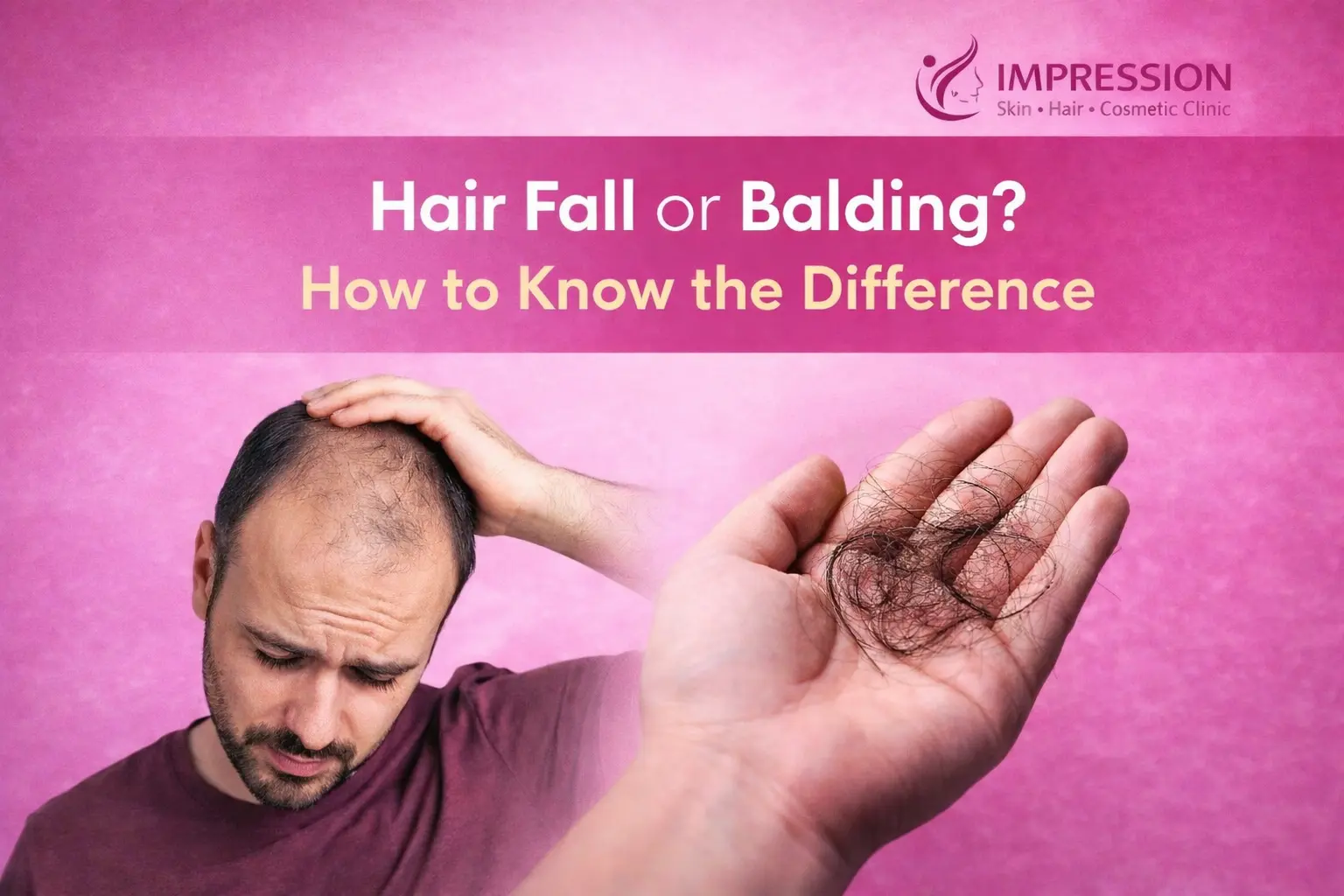
That moment when you spot a thick clump of hair in your brush, more than usual in the shower drain, or a noticeably wider parting in the mirror — it’s unsettling. Your mind immediately races to the worst-case scenario: Am I going bald?
The honest answer? Maybe, but probably not — at least not in the way you fear. Hair loss and normal hair fall are two very different things, and learning to tell them apart is the first step to getting the right help at the right time. This guide breaks it all down, clearly and without the alarm.
| 💡 Did You Know?
The average person naturally loses between 50 and 100 hairs per day. On days you shampoo, this can look like 150–250 strands because you’re collecting what accumulated between washes. This is not the same as hair loss. |
What Is Normal Hair Fall? Understanding Your Hair Cycle
Your hair is constantly cycling through three stages:
- Anagen (Growth Phase): Lasts 2–7 years. About 85–90% of your hair is in this phase at any given time.
- Catagen (Transition Phase): A short 2–3 week phase where the follicle shrinks.
- Telogen (Resting & Shedding Phase): Lasts around 3 months, after which the hair sheds and a new one begins growing.
Because different hairs are in different phases at different times, you naturally shed strands every single day. This is healthy, expected, and completely normal. The problem arises when the proportion of follicles in the telogen phase increases significantly, or when follicles stop re-entering the anagen phase altogether.
Normal Shedding vs. Baldness: The Core Differences
Understanding the difference between temporary shedding and progressive baldness is the most important thing you can do for your hair health.
| Normal Hair Shedding | Signs of Actual Baldness |
| 50–100 strands shed per day consistently | Progressively thinning patches over months |
| Hair comes out with a white bulb at the root | Shedding without visible root bulb |
| No noticeable change in scalp visibility | Visible scalp, especially at crown or temples |
| Hairline remains stable | Hairline receding or forming an M-shape |
| Even, diffuse loss across the whole scalp | Concentrated thinning in specific zones |
| Hair regrows after shedding | Miniaturised, finer hairs or no regrowth |
| Triggered by stress, illness, or diet changes | Progressive, genetic, or autoimmune pattern |
Early Warning Signs of Baldness You Should Not Ignore
Baldness rarely announces itself dramatically. It’s a slow, subtle process that most people miss until significant thinning has already occurred. Recognising the early warning signs gives you the best chance of intervention.
1. Receding Hairline
One of the earliest signs of androgenic alopecia (genetic baldness) is a slowly receding hairline, particularly at the temples. It may start as a minor shift, but compare photos taken a year apart and the change becomes undeniable.
2. Increased Scalp Visibility
If you’re noticing more scalp through your hair when you look in the mirror, in photos, or under certain lighting conditions, this is a meaningful sign. A wider centre parting or visible scalp at the crown are both red flags.
3. Miniaturisation of Hair Strands
Look closely at new hair growing from the scalp. Are they fine, thin, and shorter than they used to be? This process — called follicular miniaturisation — is the hallmark of androgenic alopecia. The follicle is progressively shrinking with each cycle.
4. Diffuse Overall Thinning
Hair that was once voluminous now looks limp and thin across the whole head. Ponytails feel noticeably smaller. This can indicate both diffuse alopecia and telogen effluvium, and warrants professional evaluation.
5. Circular or Patchy Bald Spots
Sudden, circular patches of smooth baldness on the scalp — without any hair at all — are a sign of alopecia areata, an autoimmune condition. This is distinctly different from pattern baldness and responds to different treatments.
6. Excessive Shedding That Doesn’t Resolve
If you’ve been shedding heavily for more than three to four months with no slowdown, it’s not just stress-related shedding. Persistent excessive shedding often indicates an underlying medical issue or the early stages of progressive hair loss.
| ⚠️ When to See a Dermatologist Immediately
Sudden patchy bald spots appearing within days or weeks Hair loss with scalp pain, burning, or inflammation Loss of eyebrows, eyelashes, or body hair alongside scalp hair Hair loss beginning before the age of 18 Family history of total hair loss (alopecia totalis) |
Understanding Baldness Stages: The Norwood Scale
For men, the Hamilton-Norwood Scale categorises male pattern baldness into seven distinct stages, from a normal hairline (Stage I) to complete loss of hair on the top of the head (Stage VII). Knowing your stage helps clinicians recommend appropriate, evidence-based treatment.
- Stage I – No significant hairline recession. Normal.
- Stage II – Slight recession at temples. Still within normal variation.
- Stage III – Deeper recession at temples; first cosmetically significant stage.
- Stage III Vertex – Significant thinning at the crown (vertex) begins.
- Stage IV – Hairline recession and crown thinning become more pronounced.
- Stage V – Hairline and crown thinning begin to connect.
- Stage VI – Bridge of hair between the two areas disappears.
- Stage VII – Only a horseshoe band of hair remains on the sides and back.
For women, the Ludwig Scale is used, measuring diffuse thinning at the crown across three grades. Female pattern hair loss rarely follows the receding hairline pattern seen in men.
Common Mistakes People Make When They Notice Hair Loss
When hair starts falling, it’s easy to panic and make decisions that actually make things worse. Here are the most common mistakes — and what to do instead.
Mistake 1: Self-Diagnosing and Delaying Professional Help
People spend months Googling symptoms, trying home remedies, or hoping things resolve on their own. Every month of delay is a month in which progressive follicular miniaturisation continues unchecked. Early intervention consistently produces better outcomes.
Mistake 2: Switching Between Multiple Products Quickly
Hair growth treatments take 3–6 months to show results. Most people abandon a legitimate treatment after 6 weeks, assuming it doesn’t work, then cycle through multiple products with no results from any of them. Consistency is non-negotiable.
Mistake 3: Aggressively Treating the Scalp
When people notice thinning, they often begin washing more frequently with harsh shampoos, using heavy oils, or massaging aggressively. Over-manipulation of a sensitive scalp can worsen inflammation and temporarily increase shedding.
Mistake 4: Ignoring Nutritional Status
Many people undergoing hair loss have never had their ferritin, vitamin D, thyroid panel, or zinc checked. A significant proportion of hair loss cases have a nutritional or hormonal component that is entirely correctable — and entirely missed without a blood test.
Mistake 5: Assuming Hair Loss Is Just Cosmetic
Hair loss is frequently a signal of something else going on inside the body — thyroid dysfunction, PCOS, anaemia, or autoimmune conditions. Treating the symptom without addressing the underlying cause produces temporary results at best.
| ✅ The Right First Step
Book an appointment with a dermatologist or trichologist. Request a trichoscopy (a scalp analysis tool) and a blood panel covering ferritin, TSH, T3, T4, vitamin D, zinc, and complete blood count. This gives you a complete picture before committing to any treatment path. |
Can Baldness Start Suddenly?
This is a question that comes up often, and the answer requires nuance. True genetic baldness (androgenic alopecia) is progressive and gradual — it does not appear overnight. However, several conditions can create what feels like sudden baldness:
- Alopecia Areata: Patches of hair can disappear within days to weeks. This is autoimmune, not genetic, and can be rapid.
- Telogen Effluvium: A massive, diffuse shed can happen suddenly after a triggering event (illness, surgery, delivery), making the scalp look dramatically different within 2–3 months.
- Traction Alopecia: Hairstyles that pull on the scalp over time can cause a sudden-seeming thinning at the hairline.
- Anagen Effluvium: Hair loss during the active growth phase, typically triggered by chemotherapy, which can cause rapid, widespread loss.
The key distinction is pattern vs. suddenness. Sudden, patchy loss is more likely alopecia areata. Gradual, patterned thinning over months or years is more likely androgenic alopecia. A professional assessment is the only way to confirm.
How to Tell Hair Fall vs. Baldness: A Practical Self-Check
Before your appointment, here’s a simple way to assess what you’re experiencing:
- The Pull Test: Gently grasp 50–60 hairs between your fingers and pull slowly. Losing more than 6 strands in one pull suggests active, above-normal shedding.
- The Photo Comparison: Compare photos of your hairline and crown taken 6–12 months apart under similar lighting. Progressive thinning is easiest to spot across time.
- The Scalp Check: Part your hair down the centre and look at the scalp. If the part looks wider than it did last year, this is a meaningful sign of thinning.
- Track the Duration: Normal shedding events resolve within 3–6 months. If your shedding has continued beyond this window with no reduction, it warrants professional evaluation.
Frequently Asked Questions
Q: How do I know if it’s just hair fall or the beginning of baldness?
A: Look at the pattern and duration. Temporary hair fall is usually diffuse, comes with an identifiable trigger (stress, illness, diet change), and slows within a few months. Baldness shows a progressive pattern — receding hairline, crown thinning, follicular miniaturisation — that worsens over time regardless of triggers.
Q: Can baldness start suddenly?
A: Genetic baldness is always gradual, but conditions like alopecia areata (autoimmune) can cause sudden patchy loss within days. Telogen effluvium can cause a sudden-seeming dramatic shed 2–3 months after a stressor. Neither is the same as progressive genetic baldness, and both require different treatment approaches.
Q: At what age does baldness typically begin?
A: Male pattern baldness can begin as early as the late teens or early twenties, though it becomes more noticeable in the 30s and 40s. By age 50, approximately half of men show signs of significant hair loss. Female pattern hair loss most commonly begins around menopause, though it can start earlier with hormonal conditions like PCOS.
Q: Is hair fall reversible, or does it always lead to baldness?
A: Most hair fall is reversible, especially when caused by stress, nutritional deficiencies, or hormonal changes. Genetic baldness is progressive and not reversible without medical intervention, though treatments like minoxidil, finasteride (for men), and low-level laser therapy can slow or halt progression significantly.
Q: Should I be worried if I’m losing hair in the shower?
A: Not necessarily. Losing hair during washing is normal because shampoo dislodges hairs that were already in the telogen phase. If you wash every day, the count per wash looks lower; if you wash every 3–4 days, it looks higher. Concern is warranted if you’re consistently finding very large clumps, or if your hair density is visibly decreasing over time.
Q: What is the best thing to do if I think I’m going bald?
A: See a dermatologist or trichologist early. The earlier a diagnosis is made, the more treatment options are available and the better the outcomes. Request a trichoscopy and blood panel. Avoid self-medicating or making drastic changes to your hair care routine until you have a professional opinion.
| 💇 Worried About Hair Loss? Get a Free Hair Fall Evaluation
Our trichology specialists assess your hair fall pattern, review your history, and give you a personalised action plan — no guesswork involved. Start your free evaluation today and take the first step toward clearer answers. |
Disclaimer: This article is for informational and awareness purposes only. It does not constitute medical advice. Please consult a qualified dermatologist or trichologist for diagnosis and treatment personalised to your condition.
