
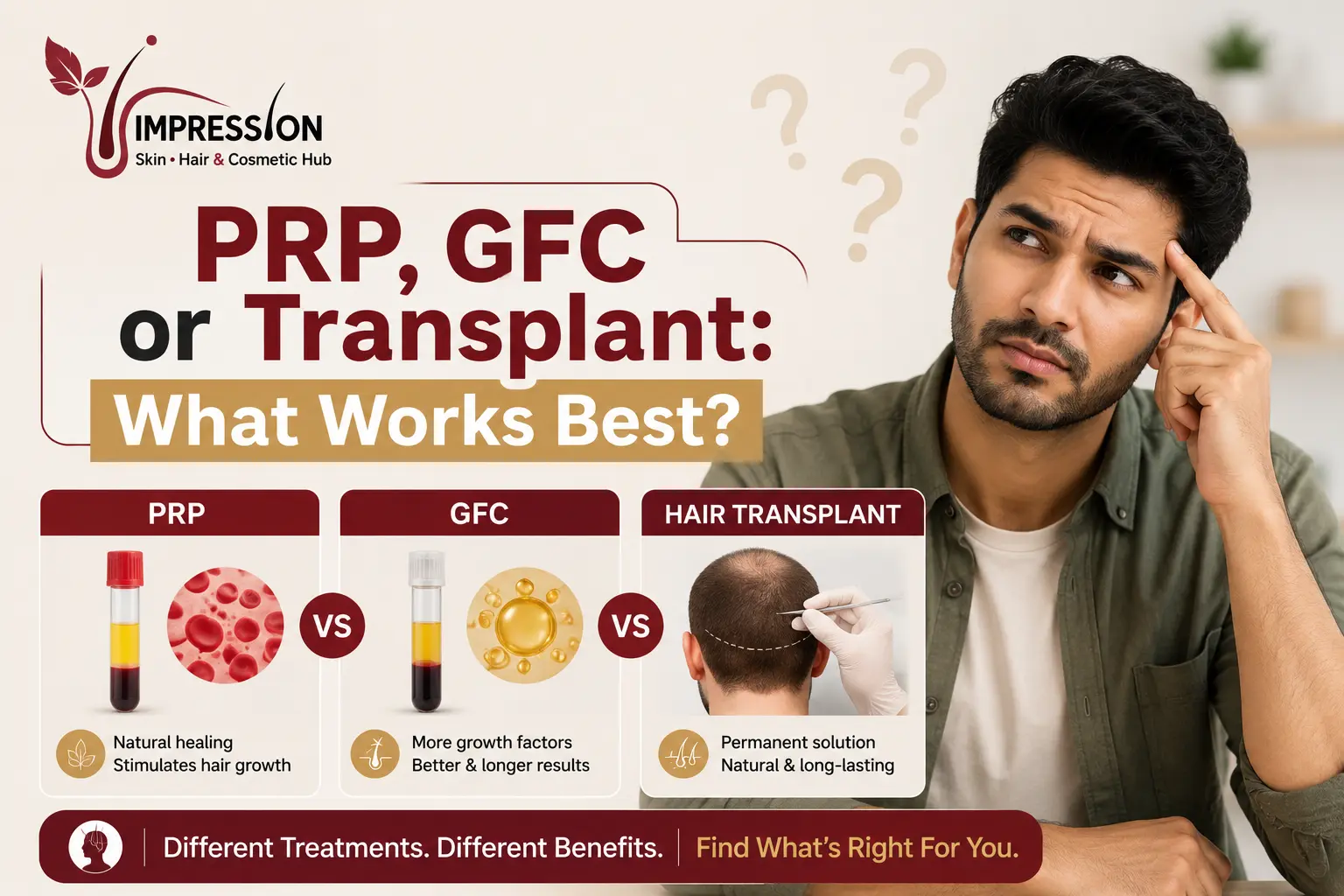
PRP. GFC. FUE. FUT. If you have been researching hair loss treatments, you have encountered this alphabet soup of acronyms — often in the same article, sometimes used as if they are interchangeable, sometimes described in ways that make them seem like competing versions of the same thing.
They are not the same thing. They address different problems at different stages of hair loss with different mechanisms, different candidate profiles, different cost structures, and fundamentally different outcomes. The confusion between them is not a failure of patient intelligence — it is a failure of how these treatments are explained in most online content, which prioritises promotional clarity over clinical accuracy.
This guide provides a genuinely clear, honest, and detailed comparison of PRP, GFC, and hair transplant surgery. By the end, you will understand what each treatment actually does, who each is actually for, what outcomes are realistic, and how to think about the decision — without the oversimplification and exaggeration that characterise most content on this topic.
| 💡 The Core Distinction in One Paragraph
PRP and GFC are regenerative treatments that support and stimulate existing hair follicles. They cannot create new hair where follicles are gone. Hair transplant surgery physically relocates living follicles from one part of the scalp to another. It is not a regenerative treatment — it is a redistribution. Each addresses a different hair loss scenario and they are not competing solutions to the same problem. |
Why Treatments Sound Similar: The Source of Confusion
The confusion between PRP, GFC, and hair transplant comes from several overlapping factors:
- All three are used in the context of hair loss and are offered by dermatology and cosmetic surgery clinics, creating the impression that they are in the same category.
- PRP and GFC are both blood-derived treatments that use growth factors, making them sound nearly identical despite meaningful differences in concentration, preparation, and mechanism.
- Some hair transplant clinics offer PRP or GFC as an adjunct to surgery, creating the impression that they are part of the same treatment.
- Marketing language across all three treatments tends toward similar promises: ‘regrow hair,’ ‘restore density,’ ‘reverse hair loss’ — without the clinical nuance that would clarify who these promises apply to.
- Cost and accessibility differences (PRP/GFC being significantly cheaper and less invasive than transplant) cause patients to frame them as ‘affordable versus expensive’ versions of the same treatment rather than fundamentally different interventions.
PRP: Platelet-Rich Plasma — What It Actually Is
PRP (Platelet-Rich Plasma) therapy involves drawing a small amount of the patient’s own blood, processing it in a centrifuge to concentrate the platelet fraction, and injecting the resulting platelet-rich plasma into the scalp at the level of the hair follicles.
How PRP Works: The Mechanism
Platelets — the blood cells primarily responsible for clotting — also contain a significant reservoir of growth factors including platelet-derived growth factor (PDGF), vascular endothelial growth factor (VEGF), transforming growth factor beta (TGF-β), and insulin-like growth factor (IGF-1). When platelets are activated (which occurs naturally during the injection process), these growth factors are released into the surrounding tissue.
In the context of hair follicles, these growth factors:
- Stimulate blood vessel formation (angiogenesis) around the follicle, improving its nutrient and oxygen supply
- Activate follicle stem cells, encouraging follicles in the telogen or early miniaturisation phase to re-enter anagen
- Reduce perifollicular inflammation through anti-inflammatory cytokine activity
- Directly stimulate hair follicle cell proliferation via PDGF and IGF-1 receptor activation
What PRP Can and Cannot Do
PRP can stimulate follicles that are miniaturised but still active — those producing thinner, shorter hairs — to improve the quality and thickness of the hair they produce. It can reduce shedding from inflammatory and stress-related causes. It can improve the scalp microenvironment for follicle health.
PRP cannot: create new follicles where none exist, reverse advanced scarring alopecia, restore hair to completely dormant follicles, or achieve the density restoration that hair transplant surgery can provide in areas of complete baldness.
PRP Protocol and Expectations
The standard PRP protocol for hair loss: 3 to 4 sessions at monthly intervals, followed by maintenance sessions every 3 to 6 months. Results are gradual — patients typically notice reduced shedding within 4 to 6 weeks and improved hair thickness and coverage at 3 to 6 months. Results are not permanent without maintenance: the growth factor stimulation is temporary and repeated treatment is required to sustain benefit.
GFC: Growth Factor Concentrate — How It Differs from PRP
GFC (Growth Factor Concentrate) is a newer, more refined blood-derived hair treatment that has gained significant traction in Indian clinics from approximately 2020 onward. Like PRP, it is derived from the patient’s own blood. Unlike PRP, the preparation process specifically isolates and concentrates the growth factors themselves rather than concentrating the platelet fraction.
How GFC Is Prepared Differently from PRP
PRP is prepared by centrifuging blood to separate the platelet-rich plasma layer from red blood cells and platelet-poor plasma. The result is a plasma with a platelet concentration approximately 3 to 5 times higher than whole blood. The growth factors in PRP are still inside the platelets and are only released upon platelet activation during injection.
GFC preparation takes this process further: after centrifugation, platelets are deliberately activated using a controlled activator (calcium chloride or similar), causing them to release their growth factor cargo. The activated plasma is then further processed to produce a concentrate of free growth factors — no longer dependent on in-vivo platelet activation for release. The resulting GFC typically has 3 to 4 times higher free growth factor concentration than equivalent-volume PRP.
Clinical Differences: PRP vs GFC
| PRP | GFC |
| Growth factors inside platelets; released after injection | Free growth factors already released; immediately bioavailable |
| Concentration: 3–5x whole blood platelets | Concentration: higher; typically 8–10x growth factor activity |
| May contain inflammatory components from platelet activation | Refined to reduce inflammatory cytokines; typically better tolerated |
| Longer-established evidence base (15+ years of studies) | Newer; growing but less extensive evidence base |
| Slightly higher pain / inflammation at injection sites | Generally better tolerated; less post-procedure scalp soreness |
| Cost: typically ₹6,000–12,000 per session | Cost: typically ₹10,000–18,000 per session |
| Available at most dermatology and hair clinics | Available at specialist clinics; preparation requires specific kit |
Which Is Better: PRP or GFC?
The honest answer is: the evidence is not yet definitive enough to conclusively declare one superior to the other. A small number of comparative studies from India and the Middle East suggest GFC produces marginally better hair thickness outcomes at 3 months; most studies show comparable efficacy on hair count and reduced shedding. The higher growth factor bioavailability of GFC is theoretically advantageous; whether this translates to consistently superior clinical outcomes across diverse patients remains an active area of research.
For most patients, the choice between PRP and GFC should be driven by: the treating clinic’s expertise with each preparation method (a well-executed PRP outperforms a poorly-executed GFC), the cost difference relative to the treatment budget, and any individual responses to previous treatment (some patients report less post-procedure discomfort with GFC).
Hair Transplant Surgery: The Fundamentally Different Category
Hair transplant surgery is not a version of PRP or GFC. It is a surgical procedure in which individual hair follicles (or groups of follicles) are physically harvested from a DHT-resistant donor area on the scalp (typically the back and sides) and transplanted to thinning or bald recipient areas. It produces permanent, growing hair in the recipient areas because the transplanted follicles retain their DHT resistance.
FUE vs FUT: The Two Surgical Methods
FUE (Follicular Unit Extraction): Individual follicular units (typically groups of 1 to 4 hairs) are extracted one by one from the donor area using a micro-punch (0.8 to 1.0mm diameter). Each extracted graft is then individually placed in a tiny incision at the recipient site. FUE leaves no linear scar — only tiny dot scars in the donor area that are invisible when the donor hair is 2 to 3mm long. Recovery is faster than FUT. The trade-off: slower extraction process and lower graft survival rates in inexperienced hands.
FUT (Follicular Unit Transplantation, ‘strip method’): A strip of scalp tissue is surgically removed from the donor area and dissected under microscopy to isolate individual follicular units. The donor site is closed with sutures, leaving a linear scar. FUT allows for larger graft numbers in a single session and some surgeons argue for higher graft survival rates. The trade-off: a linear scar that requires longer donor hair to conceal.
What Hair Transplant Can and Cannot Do
What transplant can do: permanently restore hair in areas of baldness or significant thinning, using the patient’s own DHT-resistant follicles. The transplanted hair grows for life because the follicles carry their genetic resistance from the donor area. A well-performed hair transplant on an appropriate candidate produces natural, undetectable results.
What transplant cannot do: stop the progression of hair loss in non-transplanted native hair — which is why medical treatment (finasteride, minoxidil) must continue post-transplant in most patients with androgenic alopecia. Create follicles from nothing — a patient must have adequate DHT-resistant donor hair supply. Restore hair from scarred follicles that lack any native hair in the recipient area without a natural baseline.
Who Each Treatment Is For: The Decision Framework
| Treatment | Ideal Candidate | Not Suitable For |
| PRP | Early–moderate androgenic alopecia; active telogen effluvium; diffuse thinning with miniaturised but active follicles | Complete baldness; scarring alopecia; unrealistic expectations of complete restoration |
| GFC | Same as PRP; patients who have had poor tolerance of PRP; those seeking marginally higher growth factor delivery | Same exclusions as PRP; not a substitute for transplant in advanced loss |
| Hair Transplant (FUE/FUT) | Stable androgenic alopecia (Norwood III–VI); adequate donor supply; realistic density expectations; ideally on medical treatment | Active, unstabilised hair loss; insufficient donor hair; medical conditions contraindicting surgery; unrealistic density expectations |
Realistic Outcomes: What to Expect from Each Treatment
One of the most damaging aspects of hair loss treatment marketing is the systematic exaggeration of outcomes. Here are evidence-based, honest outcome expectations for each treatment:
PRP Realistic Outcomes
- Shedding reduction: 60–80% of patients report measurable reduction in daily hair shedding within 4 to 6 weeks of the first session. This is the most consistent PRP outcome.
- Hair thickness improvement: 40–60% of patients show measurable improvement in hair shaft diameter at 3 months. This is meaningful but modest — not a dramatic density transformation.
- New hair count: 30–50% of patients show statistically significant new hair growth at 6 months (measured by trichoscopy). This typically represents miniaturised follicles producing terminal hair, not growth from dormant follicles.
- Duration without maintenance: Results typically decline 6 to 12 months after completing the initial series without maintenance sessions. PRP is not a one-time solution.
GFC Realistic Outcomes
Comparable to PRP in most measured parameters. Studies showing marginal GFC superiority report 10 to 20 percent higher hair count improvement at 3 months compared to PRP equivalents. Importantly, the quality of the treating clinic’s preparation technique is likely a larger variable in outcomes than the inherent difference between PRP and GFC.
Hair Transplant Realistic Outcomes
- Graft survival: 70–95% of transplanted grafts survive and produce terminal hair in experienced hands. The range reflects significant variation in surgeon skill and clinic quality.
- Density achievable: A hair transplant can achieve natural-appearing density in the treated area. It cannot achieve the density of an unaffected scalp — transplanted coverage is strategic, not complete. The goal is cosmetically significant improvement, not 25-year-old density.
- Visible result timeline: Transplanted hairs shed within 2 to 6 weeks post-surgery (shock loss — the follicles go through a telogen cycle). Growth begins at 3 to 4 months and the full result is visible at 12 to 18 months.
- Permanence: Transplanted follicles are permanent. They grow for life because they carry their donor area’s DHT resistance. However, surrounding native hair continues to thin without medical treatment, requiring long-term finasteride/minoxidil to maintain the overall result.
The Treatment Combination Question: PRP/GFC with Transplant
A frequent clinic recommendation is to combine PRP or GFC with hair transplant surgery. The rationale: PRP/GFC applied around the transplanted grafts at the time of surgery may improve graft survival rates through growth factor stimulation of the implanted follicles. Post-operative PRP/GFC sessions may reduce the shock loss period and accelerate the growth phase.
The evidence for this is moderately positive: several studies show 10 to 20 percent improvement in graft survival when PRP is applied intraoperatively compared to saline-only controls. It is not a dramatic effect, and it does not substitute for surgical quality — but it is a reasonable adjunct in centres with both capabilities.
PRP or GFC also serves a legitimate standalone role post-transplant: helping to stimulate the native hair surrounding the transplanted area, which is still subject to DHT-driven thinning. This combined approach — surgical redistribution of DHT-resistant follicles plus growth factor support for surrounding native hair — is the most comprehensive current approach to hair restoration in androgenic alopecia.
Frequently Asked Questions
Q: Which treatment works best: PRP, GFC, or hair transplant?
A: There is no universally ‘best’ treatment because each addresses a different problem at a different stage of hair loss. PRP and GFC are best for early to moderate androgenic alopecia, active telogen effluvium, and supporting follicle health where follicles are miniaturised but still active. Hair transplant is best for advanced androgenic alopecia where significant areas of baldness or thinning exist and the patient wants permanent density restoration. For many patients with moderate loss, the optimal approach is medical treatment (finasteride + minoxidil) plus PRP or GFC sessions, with transplant reserved for areas that do not respond adequately to this combination.
Q: Is PRP or GFC permanent?
A: No. Both are temporary treatments that produce results during and after a treatment course and require maintenance sessions to sustain. The growth factor stimulation of follicles is not permanent — follicles return to their previous state over 6 to 12 months without ongoing treatment. This is fundamentally different from hair transplant, where the transplanted follicles are permanently DHT-resistant and grow for life.
Q: Can PRP or GFC replace a hair transplant?
A: No — they address different stages and mechanisms of hair loss. PRP and GFC support and stimulate existing follicles; they cannot create new follicles or restore hair to areas where follicles are completely gone. Hair transplant physically relocates living follicles and is the only procedure that can restore visible hair density to bald or significantly thinned areas. For patients considering transplant because of moderate thinning with still-active follicles, PRP or GFC may delay or reduce the need for transplant. For patients with established baldness, PRP and GFC are supportive treatments, not alternatives.
Q: How many PRP or GFC sessions are needed?
A: The standard initial protocol is 3 to 4 sessions at 4-week intervals, followed by maintenance sessions every 3 to 6 months. The total number of sessions required depends on the degree of hair loss, the individual’s response to treatment, and whether the treatment is being used standalone or alongside medical therapy. Most patients who respond well to an initial series see declining benefit without maintenance, making this a long-term management commitment rather than a one-time treatment.
Q: How do I choose between PRP and GFC?
A: If both are available from an experienced provider, discuss the specifics with your trichologist. GFC’s higher free growth factor concentration is a theoretical advantage; whether it translates to meaningfully better outcomes for your specific condition depends on multiple factors. Practically: if your previous PRP sessions were uncomfortable due to scalp soreness, GFC’s generally better tolerability may be worth the additional cost. If cost is a significant constraint, high-quality PRP from an experienced provider is a well-evidenced, effective alternative.
Q: What is the cost of PRP, GFC, and hair transplant in India?
A: Approximate ranges in 2026: PRP per session ₹6,000 to ₹12,000; an initial course of 3 to 4 sessions typically costs ₹20,000 to ₹40,000. GFC per session ₹10,000 to ₹18,000; initial course ₹30,000 to ₹60,000. Hair transplant (FUE): ₹30,000 to ₹1,50,000+ depending on the number of grafts required (typically 1,500 to 4,000 grafts for a meaningful result) and the clinic’s reputation and location. These are indicative ranges — a detailed consultation with your treating clinic is essential for a personalised cost estimate based on your specific graft requirement.
| 💇 Free Treatment Consultation — Find Out Which Option Is Right for You
Our team of trichologists and hair restoration specialists provides honest, personalised guidance on whether PRP, GFC, medical therapy, or hair transplant (or a combination) is the most appropriate next step for your specific hair loss stage and goals. Book your free consultation today. No pressure, no upselling — just clarity. |
Disclaimer: This article is for educational purposes only. Cost estimates are indicative and vary by clinic and individual assessment. All hair restoration procedures should be undertaken following a thorough consultation with a qualified dermatologist or hair restoration surgeon.
