
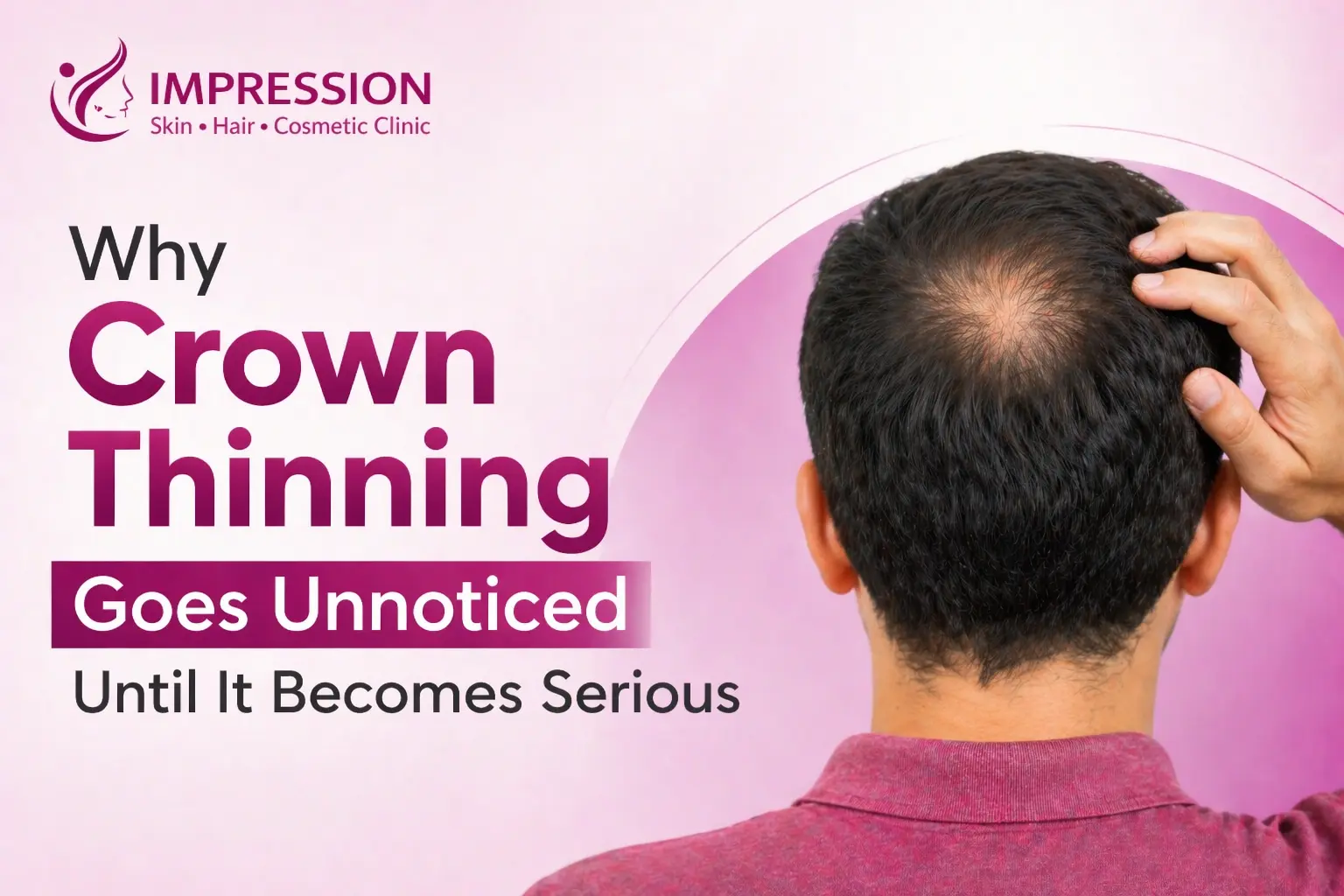
The back of your head has a blind spot — and not just optically.
Crown thinning is unique among all hair loss patterns in one critical and frustrating way: you cannot see it without deliberate effort. The front of your hairline is visible every time you look in the mirror. The sides are visible in peripheral vision and reflected in shop windows. But the crown — the vertex, the top-back of your scalp — is invisible to normal daily self-observation.
This anatomical blind spot, combined with the slow and diffuse nature of crown thinning, creates a perfect storm of delayed recognition. The average man who presents to a trichologist with significant crown thinning has been losing hair in that area for between two and four years before seeking help. By then, the bald spot is not a future risk — it is a present reality, often larger than they imagined, and the most responsive follicles to treatment have already miniaturised further than they needed to.
This guide is about closing that gap. It will show you exactly how crown thinning develops, why it is so consistently missed, how to detect it early with the right methods, and what the evidence says about stopping and reversing it. If you have ever glimpsed the top of your head in a hotel mirror or a friend’s phone camera and been surprised by what you saw — this guide is for you.
| 💡 The Crown’s Unique Challenge
Hairline recession is highly visible and easily self-monitored. Crown thinning is neither. It requires deliberate, regular, active assessment to catch early. Most men don’t do this — not because they don’t care, but because nothing in daily life prompts them to look at the top of their own head. By the time an accidental mirror angle or someone else’s photo reveals the crown, the thinning is typically already at a Norwood III Vertex or Stage IV level. |
Why Crown Hair Loss Is So Deceptive: Five Reasons Men Miss It
Understanding why crown thinning is so consistently missed is not an academic exercise — it reveals exactly what you need to change about how you monitor your own hair. Each of the following factors actively works against early detection.
Reason 1: The Anatomy of Your Blind Spot
The human eye cannot see the top of its own head. This is not a limitation you can overcome with peripheral vision or clever mirror placement in casual daily life. Every mirror glance, every passing reflection — they all show your face, your hairline, your sides. The crown is geometrically inaccessible to normal self-observation. You would need to actively position yourself under a mirror at an angle, or use a hand mirror plus a wall mirror simultaneously, to see it. Most men do this rarely if ever.
Compare this to women, who are significantly more likely to wear updos, check the back of their hair regularly for styling, and consequently detect crown thinning earlier. It is not that men’s hair loss is worse — it is that their grooming patterns lead to less frequent back-of-head monitoring.
Reason 2: Crown Hair Has a Natural Swirl (Whorl) That Can Appear Sparse
Every person’s hair grows from a central point at the crown in a circular or spiral pattern called the hair whorl or vertex swirl. At the centre of this whorl, hair growth naturally radiates outward, and the convergence of growth directions creates an area where the scalp is slightly more visible than elsewhere — even in men with a full head of hair.
This natural characteristic means that when a man does occasionally see his crown — in a photo or angled mirror — the visible scalp at the whorl centre can be dismissed as “that’s just how my hair has always been.” Only when compared to a historical baseline can the widening of that visible area be detected.
Reason 3: Crown Thinning Is Diffuse, Not Patchy
Unlike the patchy, sudden loss of alopecia areata (which would be alarming and immediately obvious), androgenic crown thinning occurs diffusely. Every follicle in the crown region miniaturises gradually and simultaneously. The density reduces uniformly rather than in discrete bald patches. This diffuse reduction is virtually impossible to detect by feel or by touch, and it registers as normal variation until the scalp visibility becomes significant.
There is no moment where a man with crown thinning wakes up and thinks “something has changed.” It is a gradient, not a step change. And gradients, as we have established, are the hardest type of change for the human visual system to detect.
Reason 4: Length and Style Provide Cover
Longer hair at the crown provides significant visual coverage of underlying thinning. A man with 5 centimetres of hair at the crown can have moderate thinning that is completely concealed by the hair lying over it. The problem is that as thinning progresses, the hair that provides this cover becomes thinner and lighter itself — so coverage diminishes from both sides simultaneously (less density below, less weight above) in a self-concealing feedback loop.
Men who keep their hair short or who shave their heads notice crown thinning immediately because the cover is removed. Men with longer hair can be genuinely shocked when they finally see their crown in a photo, because the coverage has been masking a larger area of thinning than they imagined.
Reason 5: The Photographs That Do Exist Are Not Analysed
In the era of smartphone cameras, the top of the head is actually captured quite frequently — in group photos taken from a slightly elevated angle, in photos taken on stairs or slopes, in drone shots, in restaurant booth selfies. But men rarely look at these photos analytically. They assess their face in the photo, not the top of their head. The evidence of crown thinning is often sitting in a person’s camera roll for years before they notice it.
| 🔍 The Simple Rule for Crown Awareness
Starting today: when anyone takes a photo of you from above, or when you scroll through photos taken at group events, actively look at your crown. It takes three seconds and requires no special equipment. Do this periodically and file dated photographs of your crown taken with a phone camera in top-down view. This simple habit is the most accessible early detection method available to most men. |
Mirror Test Mistakes: How Men Assess the Crown Wrong
When men do think to check their crown, they often do so using methods that systematically underestimate the degree of thinning. Here are the most common mirror assessment errors — and what to do instead.
Mistake 1: Checking in a Single Mirror from Too Far Away
Standing at normal bathroom distance and craning your neck to look up into a single mirror provides a grossly insufficient view of the crown. The angle is wrong, the distance reduces visible detail, and the foreshortening effect makes the crown appear smaller and denser than it actually is. This is the method most men use, and it is the reason most men consistently underestimate their crown thinning.
The correct method: Use a hand mirror held behind your head while facing a wall mirror. Position the hand mirror at a high angle, not parallel to the floor. Adjust until you can see a flat, direct top-down view of your crown rather than an angled or foreshortened view. This is the only way to see the crown approximately as others see it.
Mistake 2: Checking With Styled, Dry Hair
Hair products add volume, texture, and lift that conceal thinning at the crown more than anywhere else on the head. A crown assessment performed on styled, product-laden hair will consistently show a denser, more covered crown than actually exists. The hair is physically lifted away from the scalp, creating the visual impression of volume.
The correct method: Assess your crown with clean, wet hair that has been combed flat to the scalp. Wet hair reveals scalp visibility that dry styled hair conceals. The difference between a styled and wet assessment can be dramatic — and alarming — for men with moderate crown thinning.
Mistake 3: Using Indirect, Low-Angle Lighting
Bathroom lighting, which typically comes from directly above or from the front, is among the worst possible lighting for crown assessment. Light that comes from above casts shadows that fill in the spaces between hairs and makes the scalp appear less visible. The same crown that looks reasonable in bathroom lighting can look significantly more exposed under natural daylight or under a diffuse overhead light in a shop or office.
The correct method: Use natural daylight or a bright, diffuse overhead light. Position yourself directly beneath the light source. Take a photograph rather than relying on visual assessment alone — cameras capture the light reflected from the scalp in a way that the eye, which dynamically adjusts, does not.
Mistake 4: Comparing to the Wrong Reference
When men do see their crown, they often compare it to other men with visible crown thinning rather than to their own crown from years past. Compared to a man with a large bald spot, a diffusely thinning crown with moderate scalp visibility looks full. But the relevant comparison is not to others — it is to yourself. A crown that has lost 30 percent of its density looks “fine” to the untrained eye but represents three or four years of active hair loss.
The correct method: Maintain a dated photographic baseline of your crown. The comparison that matters is between your crown today and your crown 12 months ago — not between your crown today and a bald man’s crown.
Mistake 5: Checking Once and Concluding All Is Well
Crown assessment is not a one-time event. A single check provides only a snapshot. The meaningful signal is change over time, and change over time requires repeated, standardised assessments. A man who checks his crown once, decides it looks okay, and does not check again for two years is not monitoring — he is simply not noticing.
The correct method: Conduct a standardised crown assessment (wet hair, two-mirror method, bright overhead light, photograph taken top-down) every three to four months after age 25. File the photos with a date. Review at 6-month and 12-month intervals. This is the minimum monitoring required to catch early crown thinning in a meaningful treatment window.
How Crown Thinning Progresses: The Biology and the Timeline
Crown thinning in male pattern hair loss follows the same underlying mechanism as hairline recession — DHT-mediated follicular miniaturisation — but the clinical presentation and progression timeline have important differences.
The Vertex: A DHT-Sensitive Hotspot
The scalp’s vertex (crown) region contains follicles with high androgen receptor density in men with a genetic predisposition to androgenic alopecia. These follicles respond to DHT similarly to those at the temples — progressive miniaturisation across successive hair cycles. However, the crown typically shows miniaturisation slightly later than the hairline, which is why Stage III Vertex (crown involvement begins alongside hairline recession) follows Stage III (hairline recession only).
In some men — approximately 15 to 20 percent of those with androgenic alopecia — the crown is actually the primary site of progression, with the hairline remaining relatively stable for years. This variant is referred to as diffuse patterned alopecia (vertex-dominant type) and is particularly relevant for early detection, as hairline stability may misleadingly suggest that hair loss is not occurring.
The Slow Diffuse Density Reduction: What’s Actually Happening
Unlike the focal, rapid loss of alopecia areata, androgenic crown thinning is a density reduction rather than a discrete bald patch appearing. Across all follicles in the crown region simultaneously, the anagen (growth) phase shortens. Each hair cycle, the new hair produced by each follicle is slightly thinner in diameter, slightly shorter in maximum length, and slightly lighter in pigmentation.
The cumulative result of thousands of follicles each miniaturising slightly every cycle is a gradual, diffuse reduction in the visual density and coverage of the crown. There is no single moment of change — just a slow, progressive thinning that the naked eye cannot detect until coverage has dropped by an estimated 40 to 50 percent.
This 40 to 50 percent threshold is a critical number. Research on visual hair density perception has established that the human eye cannot reliably detect hair loss until approximately half the original hair density is lost. A man at the stage where thinning first becomes visually apparent has already lost nearly half his crown coverage.
| ⚠️ The 50 Percent Rule
Hair loss becomes visually apparent only when approximately 40 to 50 percent of original hair density has been lost. This means that by the time crown thinning is noticeable in a mirror or photo, the loss is already significant. The follicles that produced that lost 40 to 50 percent have been miniaturising for years. Some are still treatable; the ones that miniaturised earliest may already be dormant. This is why the window of maximum treatment effectiveness is before visible thinning, not after. |
How Quickly Does Crown Thinning Progress?
Progression rate varies substantially between individuals, but dermatological studies offer some benchmarks. In untreated men with androgenic alopecia who are actively progressing:
- Mild crown thinning (first becoming visually apparent) typically progresses to moderate thinning (clearly visible bald spot) within 3 to 5 years if untreated.
- Moderate thinning progresses to advanced crown loss (merging with hairline recession in Norwood V–VI) within a further 5 to 10 years in most cases.
- Rate of progression is faster in: men with early onset (before age 30), men with a family history of extensive loss, men with elevated DHT levels (including from exogenous testosterone), and men with chronic scalp inflammation.
- Rate of progression is slower in: men with later onset, men with lower DHT sensitivity, and men who begin DHT-blocking treatment before or during early crown thinning.
There is no reliable way to predict personal progression rate without professional monitoring, but the universal truth is that without intervention, androgenic alopecia is progressive. It does not plateau on its own, and waiting to see “how bad it gets” before acting sacrifices the most responsive follicles to unnecessary further miniaturisation.
Crown Thinning Is Not Only a Male Problem: Female Pattern Hair Loss
While this guide focuses primarily on the male experience, crown thinning is a significant and frequently underdiagnosed issue in women. Female pattern hair loss (FPHL) — also called androgenetic alopecia in women — typically presents as diffuse thinning across the crown and top of the scalp, following the Ludwig Scale rather than the Norwood Scale.
How Female Crown Thinning Differs from Male
In women, the hairline is typically preserved — the frontal hairline remains intact while the crown and top of the scalp thin progressively. The parting becomes wider. The hair feels less full and voluminous. The scalp becomes visible through the top of the hair, particularly under direct light.
Female crown thinning is often triggered or accelerated by hormonal transitions: perimenopause and menopause (declining oestrogen and progesterone remove their protective effect on follicles), postpartum hormonal changes, stopping oral contraceptives, and PCOS (elevated androgens accelerate miniaturisation). Nutritional deficiency is also a significantly more common contributing factor in women than in men.
| Female Crown Thinning | Male Crown Thinning |
| Ludwig Scale: Grade I, II, III | Norwood Scale: Stage III Vertex to VII |
| Hairline typically preserved | Hairline recession often concurrent |
| Diffuse top-of-scalp thinning | Central bald spot expanding outward |
| Hormonal triggers prominent | Genetics and DHT dominant driver |
| Nutritional deficiency more frequent | DHT load more frequently elevated |
| Minoxidil primary pharmacological option | Finasteride + minoxidil combination |
| Often misdiagnosed or dismissed | Often noticed later due to social normalisation |
Is Crown Thinning Reversible? An Evidence-Based Breakdown
The answer depends entirely on how far along miniaturisation has progressed when treatment begins. Here is a precise breakdown of what the evidence supports:
Early-Stage Crown Thinning (Follicles Miniaturised but Not Dormant)
When follicles are miniaturised — producing finer, shorter hairs but still producing some hair — they are in a recoverable state. At this stage, DHT-blocking treatment (finasteride or topical dutasteride) reduces the hormonal signal driving miniaturisation, and minoxidil actively supports follicle recovery by increasing blood supply and extending the anagen phase. In clinical studies, men who begin this combination in the early stages of crown thinning show:
- Halting of further density loss in 80 to 90 percent of cases with finasteride monotherapy.
- Measurable crown regrowth in 40 to 66 percent of cases with finasteride and minoxidil combination.
- Best outcomes in men under 40 with less than 5 years of active crown thinning.
Moderate Crown Thinning (Mix of Miniaturised and Dormant Follicles)
At this stage — the stage at which most men first seek help — the crown contains a mix of actively miniaturising follicles and follicles that have already gone dormant. Medical treatment can recover the miniaturised but active follicles; the dormant ones will not respond. This produces partial improvement: some measurable regrowth, significant slowing of further loss, but not full restoration of previous density. This is the outcome most men who “start when they notice it” actually receive.
Advanced Crown Thinning (Predominantly Dormant Follicles, Visible Bald Spot)
When a clearly visible bald spot has been present for multiple years, the majority of follicles in that area are fully dormant. Medical treatment at this stage can preserve the remaining peripheral hairs and prevent further spread but cannot restore density to the central bald area. At this point, hair transplant surgery becomes the primary tool for crown restoration.
Hair Transplant for Crown Restoration: What You Need to Know
Crown restoration via hair transplant is technically achievable but requires careful planning. The crown is a challenging area for transplant for several reasons:
- The whorl pattern requires skilled, artisanal placement of individual follicular units to mimic the natural swirl — poor placement looks immediately unnatural.
- The crown is a progressive area: native hair surrounding the transplant will continue to thin unless DHT is blocked. A transplant without medical management leads to an “island of hair” appearance as native hair recedes further.
- Donor hair supply is finite: using donor hair on the crown must be balanced against potential future hairline and midscalp needs. Aggressive crown transplants in young men can leave insufficient donor hair for later-stage needs.
- Crown transplants require a high follicular unit count to achieve meaningful density over a large area.
The consensus among experienced hair transplant surgeons is that crown restoration should be approached after at least 12 to 18 months of stable medical treatment, in men with clear pattern stability, adequate donor supply, and realistic expectations about the degree of coverage achievable.
| ✔ The Treatment Priority Framework for Crown Thinning
1. Confirm diagnosis: trichoscopy to map miniaturisation and identify active vs dormant follicles. 2. Blood panel: ferritin, vitamin D, zinc, thyroid, sex hormones — identify and correct all deficiencies. 3. Begin finasteride (with medical supervision) to block DHT and halt further miniaturisation. 4. Begin minoxidil topically to the crown: apply to the specific thinning zone, not just the hairline. 5. Scalp care: anti-inflammatory shampoo, daily scalp massage targeting the crown, avoid heat. 6. Reassess at 6 and 12 months with standardised photography. 7. Consider PRP (platelet-rich plasma) as an adjunct if response to medication is partial. 8. Explore transplant consultation after 12–18 months of stable medical treatment if desired. |
Early Detection Methods That Actually Work
You now know why detection is difficult. Here is exactly what you need to do to overcome those barriers.
The Two-Mirror Method (Monthly Minimum)
Stand in front of a bathroom mirror. Hold a second mirror (a hand mirror) angled over your crown, tilting it until you get a flat, overhead view of the vertex in the front mirror’s reflection. Look for: the size of the area where scalp is visible; the texture and density of hair in the crown zone; whether the swirl centre appears wider or more visible than before. Take a photograph of what you see in the two-mirror reflection monthly.
The Top-Down Phone Photograph (Every 3 Months)
Ask someone to stand above you and photograph your crown from directly overhead, in bright natural light or under a diffuse overhead light, with your hair clean and damp (not styled). File this photograph with the date. Review against photographs from 6 and 12 months prior. This is the most objective and reliable personal monitoring method available.
The Wet Hair Scalp Visibility Test
After washing, comb your crown hair flat in all directions from the whorl centre. Under good lighting, observe how much scalp is visible. Repeat this monthly. If the radius of visible scalp is growing over successive months, thinning is active and ongoing.
Professional Trichoscopy (Annually After Age 25)
A trichoscopy performed by a dermatologist or trichologist can detect follicular miniaturisation before it is visible to the naked eye. The device (a dermatoscope) magnifies the scalp to reveal the diameter and density of individual follicular units. This is the only method that can definitively distinguish active miniaturisation from natural density variation and provide a Norwood stage classification.
The Thread Density Test
A simple, reproducible self-test: take a small section of crown hair between two fingers, twist it gently, and assess how many hairs are palpable per centimetre. Repeat monthly in the same location. While imprecise, a consistent reduction in the palpable density of a specific area over months is a meaningful indicator of progressive thinning.
Frequently Asked Questions: Crown Thinning
Q: Is crown thinning reversible?
A: Crown thinning is partially reversible in its early stages and fully reversible when treatment begins before visible thinning has occurred. Follicles that are miniaturised but still active respond to DHT-blocking treatment (finasteride) and minoxidil with measurable regrowth in a significant proportion of men. Once follicles have become fully dormant — as in an established, visible bald spot — medical treatment can halt further spread but cannot restore density in the dormant zone. Hair transplant surgery is the option for restoring hair to permanently dormant follicle areas. The earlier treatment begins relative to the onset of thinning, the greater the proportion of recoverable follicles.
Q: How fast does crown thinning progress?
A: Without treatment, crown thinning in men with androgenic alopecia typically progresses from first becoming visually apparent to a clearly defined bald spot within 3 to 5 years. From there, continued progression merges the crown and hairline thinning over the following 5 to 10 years. However, this timeline varies substantially: men with early onset, high androgen sensitivity, or elevated DHT levels progress faster; men with later onset and lower sensitivity progress more slowly. Regular monitoring with dated photographs is the only way to assess your personal progression rate.
Q: Why does my crown look worse in some lighting?
A: Hair loss becomes more visible under certain lighting conditions — particularly direct overhead lighting (restaurants, offices, outdoor sunlight from above) and diffuse daylight. These light sources illuminate the scalp through the hair rather than creating shadows between hairs, which makes the scalp more visible. Bathroom lighting from the front or side, and warm or yellowish light, tends to cast shadows that visually fill in thinning areas, making the crown look denser than it is under more revealing light. The ‘bad lighting’ is actually revealing the truth; the flattering lighting is concealing it.
Q: Can crown thinning be a sign of something other than genetics?
A: Yes. While androgenic alopecia is the most common cause of crown thinning in men, diffuse crown thinning can also be caused by: telogen effluvium (a stress or illness-triggered shedding event that affects the crown disproportionately in some individuals); nutritional deficiency — particularly iron deficiency, which produces diffuse thinning most visible at the top of the scalp; thyroid dysfunction; and, rarely, early-stage alopecia areata affecting the vertex with diffuse rather than patchy loss. A trichoscopy and blood panel can distinguish between these causes.
Q: Will minoxidil work on the crown?
A: Yes — in fact, the original clinical trials that established minoxidil’s efficacy were specifically conducted on crown thinning, not on hairline recession. Minoxidil has a longer and stronger evidence base for crown regrowth than for hairline regrowth. Applied directly to the crown region twice daily, minoxidil has been shown to produce measurable regrowth in 60 to 70 percent of men in clinical trials. The degree of regrowth is greatest in men with early-to-moderate thinning; the effect is diminished in men with long-established, advanced crown loss.
Q: Does crown thinning affect confidence and mental health?
A: Yes, and this is clinically well-documented. Crown thinning, despite being a less immediately visible site of loss than the hairline, has a significant psychological impact when the person becomes aware of it. Research shows that individuals with crown hair loss report reduced self-confidence in social situations, increased anxiety in contexts involving overhead lighting or photography, and in some cases, reduced quality of life. These effects are real, valid, and not superficial. Dermatologists and trichologists are trained to address both the physical and psychological dimensions of hair loss, and both aspects are deserving of care.
Q: Should I cut my hair shorter if my crown is thinning?
A: Counterintuitively, shorter hair often makes crown thinning less obvious, not more. Very long hair at the crown is heavy and lies flat against the scalp, making the scalp more visible beneath it. Shorter hair, particularly with some texture or body, can visually increase the appearance of density. Additionally, shorter hair is easier to assess — you can see the true state of your crown more readily, which actually serves your monitoring needs. Many trichologists recommend that men with crown thinning opt for shorter, textured cuts rather than attempting to cover thinning with length.
Q: At what age should I start monitoring my crown?
A: The recommendation from most trichologists is to begin active crown monitoring at age 25, or earlier if you have a strong family history of early-onset hair loss. At 25, most men have established their full hair density and can create a reliable photographic baseline. Monitoring before any thinning begins provides the most valuable reference point — because by the time thinning is visible, the baseline has already shifted. Starting monitoring ‘when something looks different’ is too late; starting it proactively at 25 puts you firmly in the early-detection window.
| 💇 Free Crown Assessment — See Where You Actually Stand
Most men who come to us for a crown assessment are genuinely uncertain whether what they’re seeing is early thinning, natural variation, or their imagination. A trichoscopy gives you an objective, clinical answer — complete with follicle density mapping and a personalised treatment recommendation. Book your free assessment today. The earlier you know, the more options you have. |
Disclaimer: This article is for educational and awareness purposes only and does not constitute medical advice. All hair loss conditions require individual assessment by a qualified dermatologist or trichologist for accurate diagnosis and personalised treatment.
