
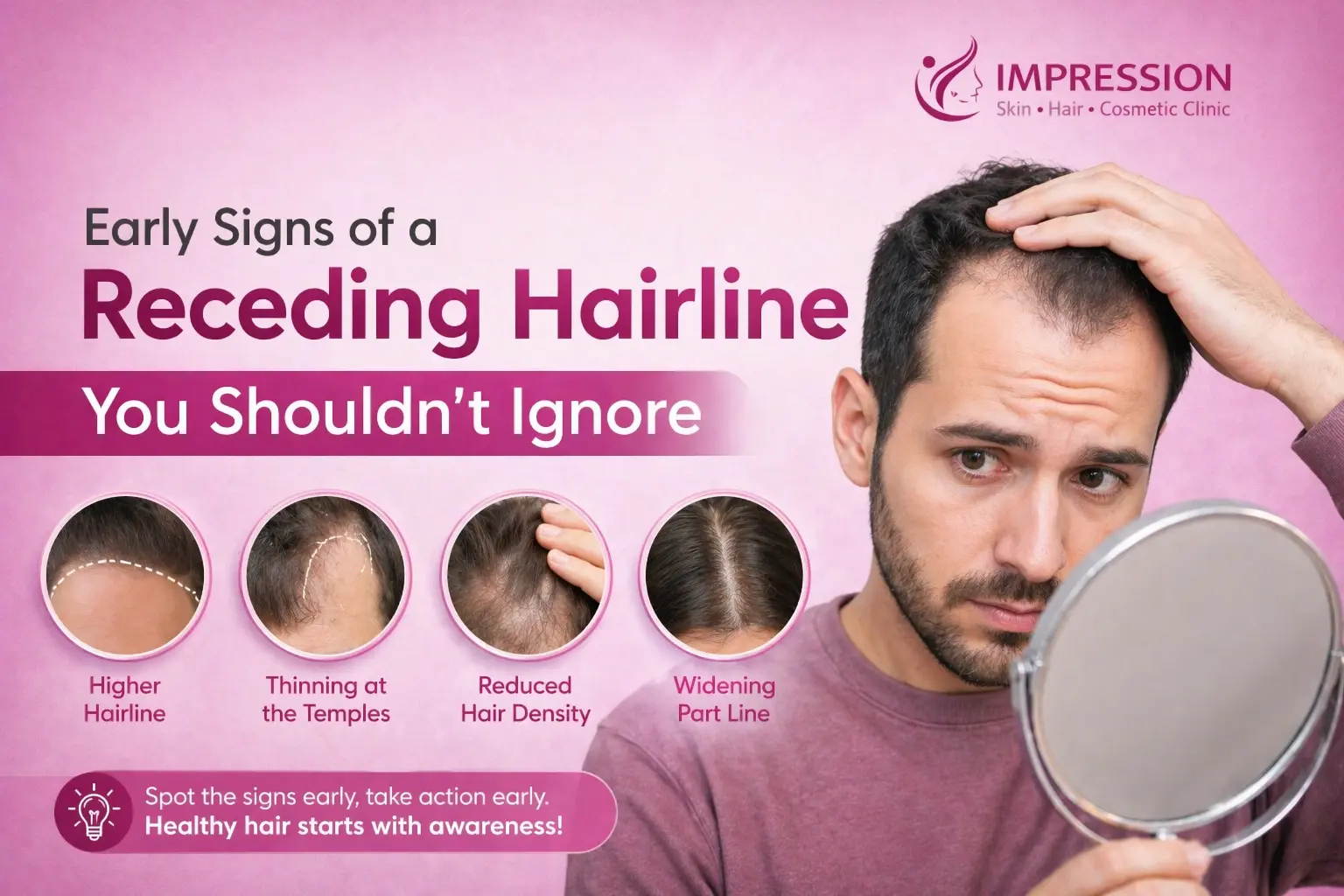
Most men who are losing their hair right now do not know it yet.
That is not an exaggeration. The hair follicle doesn’t announce its intentions. There is no dramatic overnight transformation. A receding hairline is a slow, incremental process that unfolds over months and years — so gradually that the person experiencing it is often the last to notice. By the time most men acknowledge the change, they have already progressed past the stages where the widest range of treatment options is available.
This is the central problem with receding hairlines: the window of maximum opportunity is the window of minimum alarm. When intervention is easiest and most effective, the change is so subtle that most men dismiss it. When it becomes undeniable, the most impactful early interventions have already been missed.
This guide is designed to close that gap. It will show you exactly what to look for, why the hairline is typically the first site of change in male pattern hair loss, how to accurately assess your own hairline, and what the evidence says about reversibility and treatment. By the end, you will know more about your own hairline than most men ever learn.
| 💡 The Opportunity Cost of Denial
Studies in dermatology consistently show that men who seek treatment at Norwood Stage II or III achieve significantly better and longer-lasting results than those who begin treatment at Stage IV or V. The hair follicle miniaturises progressively over time — once a follicle is fully miniaturised and scarred, no currently available treatment can revive it. The biology of hair loss rewards early awareness. |
Why the Hairline Changes First: The Biology Behind It
To understand why the hairline recedes before other areas thin, you need to understand the biology of androgenic alopecia — the technical term for male pattern hair loss, which accounts for approximately 95 percent of hair loss in men.
Androgenic alopecia is driven by the interaction between genetics and a hormone called dihydrotestosterone, more commonly known as DHT. DHT is a potent derivative of testosterone, produced when the enzyme 5-alpha reductase converts testosterone in the scalp tissue. When follicles carry a genetic sensitivity to DHT, the hormone binds to androgen receptors within those follicles and progressively interferes with the hair growth cycle.
The specific mechanism is follicular miniaturisation: DHT shortens the anagen (growth) phase of the hair cycle while extending the telogen (resting) phase. Over successive cycles, the follicle produces a thinner, shorter, and more lightly pigmented hair. Eventually, it produces only a fine, unpigmented vellus hair — barely visible to the naked eye — and finally goes dormant entirely.
Why the Temples and Frontal Hairline Specifically?
Not all follicles on the scalp carry equal sensitivity to DHT. The follicles at the temples and along the frontal hairline are, in the majority of men with androgenic alopecia, the most sensitive to DHT’s miniaturising effect. This is an inherited characteristic — a feature of those follicles’ androgen receptor density and their local 5-alpha reductase activity.
The follicles at the back and sides of the scalp — the occipital and parietal regions — are comparatively DHT-resistant. This is why they are described as the “donor area” in hair transplant surgery: they retain their hair even in advanced hair loss cases, and transplanted to DHT-sensitive zones, they retain that resistance and continue to grow.
This differential sensitivity explains the characteristic pattern of male hair loss: temples first, then the frontal hairline, then the crown — while the sides and back remain. It also explains why the hairline is the earliest and most reliable indicator that androgenic alopecia is underway.
The Role of Genetics: Your Father’s Hairline Is Not the Only Predictor
The inheritance pattern of androgenic alopecia is polygenic — meaning it is influenced by multiple genes, inherited from both parents. The common belief that hair loss only comes from the mother’s side of the family is a persistent myth. Research shows that the androgen receptor gene is located on the X chromosome (and is therefore inherited from the mother), but dozens of other genes influencing DHT production, 5-alpha reductase activity, and follicle sensitivity are inherited from both parents.
In practical terms, this means that looking only at your maternal grandfather’s hairline gives you an incomplete picture. Your paternal grandfather, your father, your maternal and paternal uncles — the pattern across all of these relatives gives a much more accurate indicator of your personal risk and likely pattern of progression.
It also means that hair loss can appear in men with no visibly affected male relatives, because the combination of genetic variants from both parents can produce a susceptibility that neither parent exhibited alone.
| 🧬 Understanding DHT Sensitivity
Not all hair loss is about how much DHT your body produces — it is about how sensitive your follicles are to the DHT that is produced. Two men with identical testosterone and DHT levels can have completely different hair outcomes based solely on the androgen receptor sensitivity of their follicles. This is why DHT-blocking treatments (like finasteride) work for many men but not all, and why some men with naturally low testosterone still experience significant hair loss. |
Early Visual Clues of a Receding Hairline: What to Actually Look For
The early signs of a receding hairline are subtle enough that most men rationalise them away. Here, in detail, are the specific visual indicators that should prompt closer attention — and action.
Sign 1: The Temples Pull Back Asymmetrically
One of the earliest and most commonly missed signs is that one temple recedes before the other. Because the change is asymmetric, the brain interprets it as a normal variation in face shape or styling rather than hair loss. Look at both temples in a direct, front-facing mirror. If one appears slightly higher or more angular than the other, this asymmetric temple recession is a meaningful early signal.
The temple recession typically follows one of two early patterns: either the hair pulls straight back from the corner of the forehead (creating a more angular hairline), or the recession is curved, drawing the front hairline back while leaving a “widow’s peak” or pointed central tuft. Both are variants of the same process.
Sign 2: The Hairline Appears Higher in Photos Than You Remember
One of the most reliable detection methods is photo comparison over time. The human brain adapts to gradual change and normalises it so effectively that you become functionally blind to the progression. What your brain ignores, photographs document objectively.
Find a photograph from two to three years ago with a clear view of your hairline. Compare it — not to your current mirror reflection, but to a current photograph taken under identical lighting and angle. Look specifically at: the distance from your eyebrows to your hairline; the width and definition of your temples; whether the front corners of your hairline appear sharper or more angular. These comparisons are often revelatory.
Sign 3: The “Morning Look” Exposes What Styling Conceals
Many men unconsciously adopt hairstyles and styling habits that conceal or minimise the appearance of hairline recession. Swept-forward fringes, volume-building products, and strategic parting can effectively mask moderate recession. The true state of the hairline is most visible with clean, wet, unstyled hair pulled back from the face.
Make it a practice to assess your hairline in this state: freshly washed, no products, hair pulled back. If the hairline looks significantly different — higher, more angular, more defined at the temples — than your styled daily appearance, you have already developed compensating styling habits, which is itself a diagnostic sign.
Sign 4: The Forelock Becomes an Island
As temple recession deepens on both sides, the central tuft of hair at the front of the hairline can begin to appear isolated — an island of denser hair surrounded by increasingly sparse territory. This is sometimes called the “forelock” effect and is characteristic of Stage III to IV hairline recession. If your centre front hair feels notably denser than the hair immediately to its sides, this disparity in density is worth monitoring.
Sign 5: Increased Hair on the Pillow, Brush, and Shower After Brushing the Front
While general diffuse shedding affects all areas, the early shedding associated with hairline recession is often more concentrated. Pay attention to where the shed hairs come from during brushing. If you notice an increased number of hairs coming specifically from the front and temples when you style, rather than from the overall scalp, this localised shedding pattern can be an early indicator of hairline-specific androgenic activity.
Sign 6: The Hairline Loses Its “Definition”
A healthy hairline has a clear, relatively sharp boundary between the hair-bearing scalp and the forehead. As follicular miniaturisation begins, this boundary becomes softer and less defined. The front edge of the hairline develops a gradient rather than a line: very fine, sparse, barely visible hairs appear beyond the main hairline, creating a “fuzzy” or indistinct border.
This miniaturisation at the hairline edge — visible as a vague, transparent haze of vellus hairs rather than a clean border of terminal hairs — is one of the earliest microscopic signs that a trichoscopy will confirm, and one that a careful observer can begin to detect with the naked eye in good lighting.
Sign 7: Sunburn or Sensitivity Where There Was None Before
A practical and often overlooked indicator: if your forehead or temples are suddenly getting sunburned in areas that previously had hair coverage, the skin in those areas has been gradually exposed. Men who notice unexplained sunburn lines creeping back toward the scalp are often experiencing hairline recession that they have not yet consciously registered.
| 🔍 The ‘40-40-40’ Self-Assessment
Every man should do this self-assessment once a year after age 25: 1. Stand 40 cm from a mirror in good, even lighting. Wet your hair, comb it straight back, and assess the hairline honestly. 2. Take a photo from 40 cm away, directly facing the camera. File it with a date. 3. Compare it to the photo from 40 weeks ago (roughly a year). Progression that is invisible day-to-day becomes undeniable across a 12-month comparison. This is the simplest and most reliable early detection method available. |
The Norwood Scale: Mapping Where You Are and What It Means
The Hamilton-Norwood Scale is the clinical standard for classifying male pattern hair loss. Understanding it is not just academic — your position on the scale determines which treatments have the strongest evidence base, what outcomes you can realistically expect, and whether and when surgical options become relevant.
| Stage | What It Looks Like | What You Should Know |
| Stage I | No significant hairline recession. Full hair coverage. Baseline. | No action needed beyond monitoring. |
| Stage II | Slight recession at the temples forming a minor M-shape. Often dismissed as natural variation. | Ideal time to begin preventive treatment if desired. |
| Stage IIA | More pronounced recession across the front hairline, temples and front recede evenly. | First clearly cosmetic stage. Many men still deny loss at this point. |
| Stage III | Deep temple recession that is clearly visible. Often the stage men finally acknowledge the change. | Minoxidil and finasteride produce best results started here. |
| Stage III Vertex | Hairline recession plus the beginning of a bald spot or thinning at the crown (vertex). Dual-front progression. | Critical stage — both areas now active. Prompt treatment recommended. |
| Stage IV | More severe hairline recession and significant crown thinning. A bridge of hair separates the two thinning zones. | Cosmetic impact is significant. Medical and procedural options relevant. |
| Stage V | The separating bridge of hair narrows considerably. Two thinning zones begin to merge. | Hair transplant candidacy assessment often begins here. |
| Stage VI | The bridge disappears. Hairline and crown thinning merge into one large area. Side hair remains. | Transplant from the stable donor area is the primary option. |
| Stage VII | Only a horseshoe band of hair remains on the sides and back of the scalp. Maximum hair loss. | Hair systems, advanced transplant, or acceptance. |
| ⚠️ The Critical Treatment Window: Stages II–III
The most important thing the Norwood Scale communicates is where the treatment window is. At Stage II and early Stage III, the follicles are miniaturised but not yet fully dormant. Medical treatments — particularly finasteride and minoxidil in combination — can halt miniaturisation and in some cases partially reverse it. At Stage V and beyond, follicles at the affected sites are largely dormant, and medical treatment cannot revive them. Early identification and early action produce categorically different outcomes. |
Why Most Men Ignore Early Hairline Changes: The Psychology of Denial
Understanding that hairline recession is happening and accepting it are two very different cognitive experiences. Research in behavioural psychology identifies several mechanisms that make early hair loss recognition particularly difficult for men.
The Familiarity Effect
The human visual system is extraordinarily good at detecting sudden change but genuinely poor at detecting slow, incremental change. When you look in the mirror every day, your brain builds a running average of your appearance and updates it continuously. By the time the objective change is significant, your brain has already normalised it. This is not a character flaw or vanity — it is a fundamental feature of human perception.
The “It’s Just Styling’ Rationalisation
Early hairline changes are almost always accompanied by unconscious styling adaptations: a slightly different parting, a fringe worn a touch lower, more product to build volume. These adaptations are so instinctive that men often make them without conscious awareness. When they do notice the hairline, the rationalisation “it’s just how I’m wearing my hair today” provides immediate psychological cover.
Social Taboo Around Hair Loss Concern
There is a pervasive cultural message that men who are concerned about hair loss are being vain or shallow. This stigma actively prevents men from seeking information and help early. The reality is that hair loss concern is clinically documented to affect self-esteem, confidence, and quality of life in men just as it does in women. Acknowledging concern early is not vanity — it is clinical intelligence.
The Comparison Trap
Men often assess their hairline not against their own baseline from years ago, but against the men around them who have advanced, visible hair loss. Compared to a man who is visibly bald, a receding hairline at Stage II seems trivial. But the relevant comparison is not to others — it is to your own previous state. A Stage II recession compared to your Stage I baseline is meaningful, regardless of where others stand.
Can a Receding Hairline Grow Back? What the Research Actually Says
This is the question most men want answered first, and the honest answer requires distinguishing between three different outcomes: halting progression, partial reversal, and full reversal.
Halting Progression: Highly Achievable
For men who begin treatment at Stage II or III, halting further recession is an achievable goal for the majority. Finasteride (1mg daily, oral) reduces DHT in the scalp by approximately 70 percent and has been shown in multiple large-scale clinical trials to stop hairline progression in around 83 percent of men who use it consistently over two years. This is not a cure, but it is a meaningful and significant outcome: a hairline frozen in place is a fundamentally different situation from a hairline that continues to retreat.
Partial Reversal: Possible, Particularly in Early Stages
Minoxidil (2 or 5 percent topical, applied directly to the hairline and temples) increases blood flow to the follicle, extends the anagen phase, and can stimulate regrowth of miniaturised follicles that have not yet gone fully dormant. Randomised controlled trials show that approximately 60 to 70 percent of men using minoxidil experience some measurable regrowth. The effect is most pronounced in early stages (II to III) and is significantly diminished in advanced stages (V and beyond).
When finasteride and minoxidil are used together, the combined effect is greater than either alone. This combination is currently the most evidence-supported non-surgical approach to hairline management.
Full Reversal of Advanced Recession: Not Achievable with Current Medical Treatment
A fully dormant follicle — one that has been miniaturised for years and has ceased producing any detectable hair — cannot currently be revived by finasteride or minoxidil. This is the biological reality that makes early intervention so important. Once a follicle is gone, hair transplant surgery is the only option for restoring hair in that specific area.
Hair Transplant: The Option When Medical Treatment Is Insufficient
Follicular Unit Extraction (FUE) and Follicular Unit Transplantation (FUT) involve relocating DHT-resistant follicles from the back and sides of the scalp to the thinning hairline and temples. Transplanted follicles retain their DHT resistance and continue to grow permanently in their new location. The results of modern FUE procedures are remarkably natural when performed by an experienced surgeon on an appropriate candidate.
The ideal candidate for hairline transplant is a man who: has stabilised his loss with medical treatment, has sufficient donor hair at the back and sides, has realistic expectations about coverage, and has a Norwood pattern that allows logical, future-proof hairline design. Attempting transplant without stabilising the underlying loss means the native hair around the transplant will continue to thin, requiring further procedures.
| ✔ The Evidence-Based Treatment Priority Order
1. Finasteride (oral or topical) to halt DHT-driven miniaturisation — most critical first step. 2. Minoxidil (topical or oral, low-dose) to support follicle health and stimulate early-stage regrowth. 3. Optimise nutritional status (ferritin, vitamin D, zinc) — deficiencies reduce treatment efficacy. 4. Scalp health: anti-inflammatory shampoo, regular scalp massage, avoid heat trauma. 5. Hair transplant consideration only after 12–18 months of stable medical treatment. Always begin with a dermatologist or trichologist consultation before starting medication. |
Is a Receding Hairline Genetic Only? Other Contributing Factors
While genetics is the dominant driver of male pattern hair loss and hairline recession, it is not the only factor. Several external contributors can accelerate a genetically determined hairline recession or, in some cases, trigger temporary hairline thinning in men with no significant genetic predisposition.
Androgenic Acceleration: Anabolic Steroids and Testosterone Therapy
Exogenous testosterone — from anabolic steroid use or testosterone replacement therapy (TRT) — dramatically increases the substrate available for 5-alpha reductase to convert to DHT. In men with genetic susceptibility to androgenic alopecia, this acceleration can be dramatic: years of projected hair loss compressed into months. Men on TRT or who have used anabolic steroids and notice hairline acceleration should discuss DHT-blocking co-treatment (finasteride or dutasteride) with their prescribing physician.
Chronic Stress and Cortisol
While stress does not directly cause the genetic miniaturisation of androgenic alopecia, it can trigger telogen effluvium that preferentially affects the more vulnerable, already-miniaturising follicles at the hairline first. Chronic cortisol elevation also suppresses the anti-androgen effects of certain hormones, creating a less protective hormonal environment for DHT-sensitive follicles.
Nutritional Deficiencies
Iron deficiency, vitamin D deficiency, and zinc insufficiency do not cause androgenic hair loss, but they worsen it. Follicles that are already under DHT-mediated stress are the first to fail when nutritional support is inadequate. Many men respond poorly to standard hair loss treatments because underlying nutritional deficiencies are undermining follicle function. Optimising these levels is not just supportive — it meaningfully improves treatment outcomes.
Traction and Mechanical Stress
Men who consistently wear tight headwear (helmets, hats worn daily under tension, headbands), or who use tight hairstyles, can experience traction alopecia that mimics or overlaps with genetic hairline recession. The temple and frontal hairline are particularly vulnerable to traction. Identifying and removing the mechanical cause can allow recovery of follicles that are not yet permanently damaged.
Scalp Inflammation
Seborrhoeic dermatitis, psoriasis, and folliculitis of the scalp create chronic inflammatory environments that accelerate DHT-mediated follicular miniaturisation. Men with genetically susceptible follicles who also have chronic scalp inflammation experience faster progression than those with equivalent genetics and a healthy scalp. Treating scalp inflammation is an underappreciated but clinically meaningful part of hairline preservation.
| Genetic Factors | Modifiable Accelerants |
| Androgen receptor gene sensitivity | DHT load from anabolic steroids or TRT |
| 5-alpha reductase enzyme activity | Chronic stress and cortisol elevation |
| Number of DHT-sensitive follicles inherited | Iron, vitamin D, or zinc deficiency |
| Age of onset (partly genetic) | Scalp inflammation (seborrhoeic dermatitis, psoriasis) |
| Rate of follicle miniaturisation (partly genetic) | Traction from hairstyles or headwear |
| Family pattern and extent of eventual loss | Poor scalp hygiene and product buildup |
What to Do If You Think Your Hairline Is Receding: A Step-by-Step Guide
Knowing is only the first step. Here is a clear, evidence-grounded action plan for men who suspect or have confirmed early hairline recession.
- Document your baseline. Take standardised photographs today: front-facing, top-down, and both sides. Repeat in 3 months and again at 6 months. This documentation is invaluable — both for your own monitoring and for any specialist you consult.
- Get a professional trichoscopy. A trichoscopy (scalp dermoscopy) performed by a dermatologist or trichologist can detect follicular miniaturisation before it is visible to the naked eye. This is the gold standard early diagnostic tool and gives you both confirmation and a Norwood stage classification.
- Get a blood panel. Request ferritin, vitamin D (25-OH), zinc, thyroid panel (TSH, free T3, free T4), and SHBG. These identify nutritional and hormonal contributors that are often missed and that significantly affect treatment outcomes.
- Discuss finasteride with your doctor. If androgenic alopecia is confirmed, finasteride is the most effective pharmacological intervention available. Discuss the evidence, the side effect profile (which, contrary to popular belief, affects a small minority of users and is reversible on discontinuation in most cases), and whether it is appropriate for you.
- Begin minoxidil. Topical minoxidil can be started without a prescription in most countries. Apply to the hairline and temples, not just the crown. Use twice daily or as directed. Do not discontinue within the first 3 months — an initial increase in shedding (the ‘dread shed’) is normal as resting hairs are pushed out before regrowth begins.
- Optimise the scalp environment. Use an anti-inflammatory, sulphate-free shampoo. Incorporate a 4-minute daily scalp massage. Avoid products with high alcohol content applied to the scalp. Limit heat styling.
- Address lifestyle factors. Prioritise sleep (7–9 hours), manage chronic stress actively, ensure adequate protein intake, and, if relevant to your situation, discuss the hair implications of anabolic steroid or testosterone use with your physician.
Frequently Asked Questions: Receding Hairline
Q: Can a receding hairline grow back?
A: Partial regrowth of a receding hairline is possible, particularly in the early stages of miniaturisation. Minoxidil can stimulate regrowth of follicles that have miniaturised but not yet gone dormant, while finasteride can halt the DHT-driven process that is causing the recession. The combination of both is the most effective medical approach. However, a hairline that has been fully receded for many years, with dormant follicles, cannot recover with current medical treatments — only hair transplant surgery can restore hair to those areas. The earlier treatment begins, the greater the potential for meaningful regrowth.
Q: Is a receding hairline genetic only?
A: Genetics is the primary driver, but not the only factor. The inherited sensitivity of your follicles to DHT determines whether you are at risk, but several modifiable factors can significantly accelerate or worsen the rate of recession: anabolic steroids and testosterone replacement therapy dramatically increase DHT load; nutritional deficiencies (particularly iron and vitamin D) worsen follicle resilience; chronic stress and scalp inflammation create a hostile environment for already-vulnerable follicles; and mechanical traction from tight hairstyles can cause hairline loss even without genetic predisposition. Addressing these accelerants cannot reverse genetic susceptibility, but it meaningfully alters the rate of progression.
Q: At what age does a hairline usually start receding?
A: Male pattern hair loss can begin as early as the late teens or early twenties in men with strong genetic predisposition. The most common onset period is between 25 and 35. However, onset can occur at any age — some men experience significant recession in their 20s while others do not notice changes until their 40s or 50s. Early onset is generally (though not always) associated with more extensive eventual hair loss. If you notice changes before age 25, seeking a specialist opinion early is particularly important.
Q: How do I know if my hairline is receding or just a mature hairline?
A: A mature hairline is a normal developmental change that occurs in most men between ages 17 and 29, in which the adolescent hairline moves back by approximately 1 to 1.5 cm and takes on a more angular, adult appearance. It is not accompanied by progressive recession — it happens once and stabilises. A receding hairline continues to move back, is accompanied by follicular miniaturisation (finer, shorter hairs at the hairline edge), and progresses over years. The distinguishing test: if your hairline has been stable for 2 to 3 years, it is likely mature. If it continues to move back, it is receding. Photo comparison over time is the most reliable personal assessment tool.
Q: Does wearing hats cause or worsen a receding hairline?
A: Wearing a hat does not cause androgenic alopecia or trigger DHT-mediated miniaturisation — that is a myth. However, hats that are consistently worn very tight, creating sustained traction on the hairline edges, can contribute to or worsen traction alopecia at those sites. If your hat fits comfortably and is not pulling on the hairline, it poses no risk. In fact, hats that protect the scalp from UV radiation reduce UV-induced scalp inflammation, which is mildly beneficial for scalp health.
Q: How quickly does a receding hairline progress?
A: Progression rate varies significantly between individuals. Some men progress from Stage II to Stage IV within three to five years; others remain at Stage II for a decade or more. There is no reliable way to predict personal progression rate without professional monitoring, though early-onset hair loss (before age 25) and a family history of extensive loss are associated with more aggressive progression. This unpredictability is a strong argument for beginning treatment early rather than waiting to see how bad it gets — by the time progression accelerates, valuable treatment windows may have closed.
Q: Can finasteride regrow a receded hairline?
A: Finasteride’s primary action is halting further DHT-mediated miniaturisation, not reversing it. However, in follicles that are miniaturised but still producing some hair (characteristic of early recession at Stage II–III), reducing DHT exposure can allow those follicles to partially recover and produce thicker, longer hairs over time. In clinical studies, approximately 30 to 40 percent of men using finasteride experience some measurable hairline regrowth, while a larger majority experience stabilisation. For meaningful regrowth of significantly receded areas, combining finasteride with minoxidil gives the best pharmacological outcome.
Q: Is there a way to predict how much hair I will lose?
A: The most reliable predictors of eventual hair loss extent are: your own current Norwood stage and rate of progression over the past 1–2 years; the pattern and extent of hair loss in close male relatives (father, paternal grandfather, maternal grandfather, uncles); age of onset (earlier onset generally correlates with more extensive eventual loss); and in some cases, genetic testing services that assess variants in the androgen receptor and related genes. None of these give a certain prediction, but they allow a probability-weighted view. A trichologist can integrate these factors into a personalised risk assessment.
| 💇 Book a Free Hairline Assessment
Not sure whether what you’re seeing is a mature hairline, early recession, or something else entirely? Our specialist team offers a free, no-obligation hairline assessment, including trichoscopic analysis and a personalised conversation about your options. The best time to understand your hairline was five years ago. The second best time is today. |
Disclaimer: This article is for educational and awareness purposes only and does not constitute medical advice. Always consult a qualified dermatologist or trichologist before starting any treatment for hair loss
